

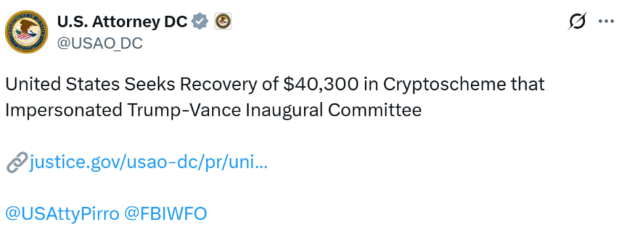
The U.S. Department of Justice (DOJ) has recovered $40,300 in cryptocurrency stolen in a scam that impersonated the Trump-Vance Inaugural Committee, according to a recent legal filing. The recovered funds, traced through blockchain analysis, highlight the increasing use of crypto in online fraud—and the tools authorities are using to fight back.
Crypto Scam Targeted Political Donor via Email
On December 24, 2024, a scammer sent a fraudulent email that appeared to originate from Steve Witkoff, the co-chair of the Trump-Vance Inaugural Committee. The email address used a deceptive domain—@t47lnaugural.com—replacing a lowercase “i” with an “l” to trick the recipient.
Believing the email was authentic, the victim transferred $250,300 in USDT (Tether) on the Ethereum blockchain to a wallet controlled by scammers.
The stolen funds were immediately laundered through multiple cryptocurrency wallets, making recovery difficult.
FBI Recovers $40,300 Through Blockchain Tracking
Thanks to blockchain analysis tools, the FBI successfully traced and recovered $40,300 of the stolen USDT. The DOJ filed a civil forfeiture complaint to return the funds to the victim.
“Impersonation scams take many forms and cost Americans billions each year,” said Steven Jensen, Assistant Director in Charge at the FBI’s Washington Field Office. He emphasized the importance of double-checking email senders and never sending crypto to unknown contacts.
Tether Credited for Helping DOJ Freeze Stolen Funds
The DOJ credited Tether, the issuer of USDT, for assisting law enforcement in freezing and transferring the compromised funds. This marks another instance of Tether’s cooperation in law enforcement efforts. In June 2025, Tether was also recognized for helping seize $225 million in USDT connected to a large-scale scam targeting global victims.
Tether’s intervention shows the growing role of stablecoin issuers in combating crypto crime.
Crypto Donations and Security Risks
The scam coincided with a surge in crypto political fundraising. In May 2024, former President Donald Trump began accepting cryptocurrency donations via Coinbase Commerce, supporting assets such as Bitcoin, Ethereum, Dogecoin, and Solana.
As political fundraising expands into digital assets, cybersecurity risks have grown, making it essential for donors and campaigns to verify all communications.
Disclaimer
This content is for informational purposes only and does not constitute financial, investment, or legal advice. Cryptocurrency trading involves risk and may result in financial loss.