

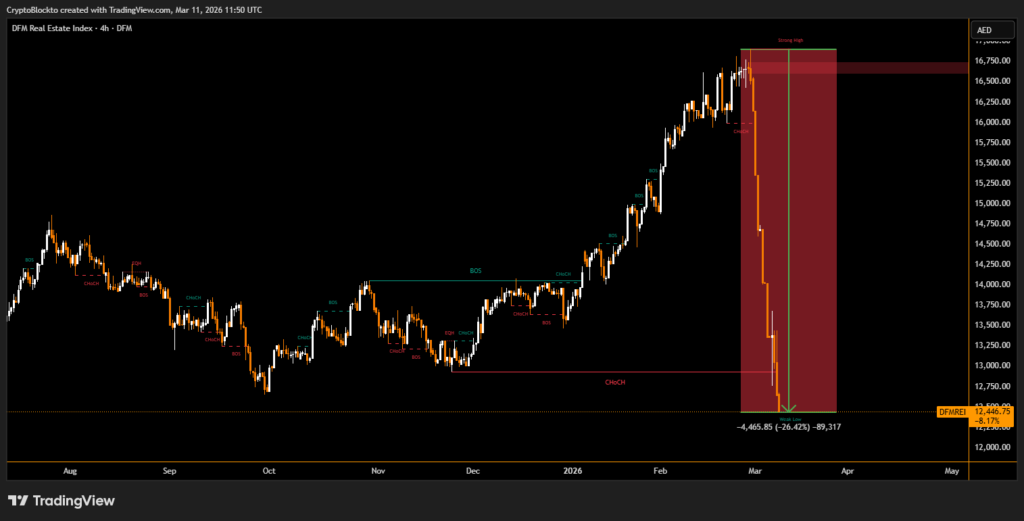
Dubai’s property market faced a sharp slowdown after the start of Operation Epic Fury on Feb 28. The Dubai Financial Market (DFM) Real Estate Index fell to 12,453 on Monday from 16,306 on Feb 27, an 18.1% drop. Transaction volumes and values also declined sharply. In Week 9 (Feb 23–Mar 1), total sales reached Dhs20.72 billion across 5,473 transactions, while Week 10 (Mar 2–8) recorded Dhs10.37 billion across 3,038 deals, representing a 49.9% decline in value and 44.5% fewer transactions. Weekday-only comparisons confirm the market’s run-rate was effectively halved after the conflict.
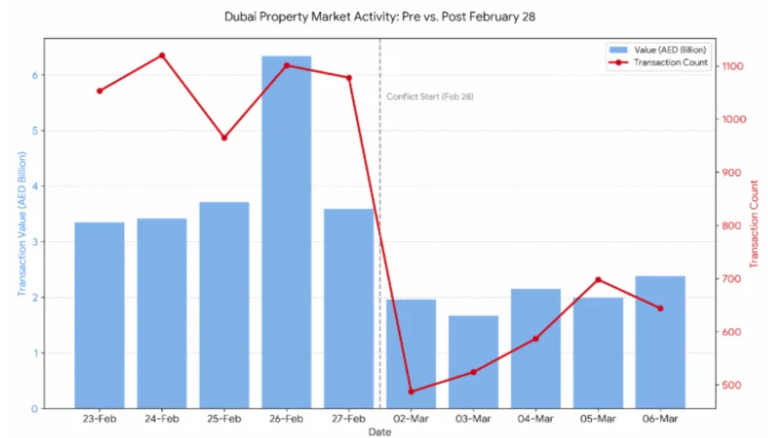
Chart shows the DFM Real Estate Index. It fell ~26% from its Feb 26 peak of 16,910 to ~12,455 over recent sessions.
Off-Plan Properties Continue to Lead the Market
Off-plan properties remained the dominant segment despite the slowdown. Their share of built-property value rose from 62.4% to 66.2% week-on-week, with off-plan flats contributing 78% of total off-plan value. Ready-property sales stayed largely apartment-led. High-end transactions showed resilience, exemplified by a Dhs422 million apartment sale at Aman Residences in Jumeirah Second. Mortgage registrations eased but remained meaningful, accounting for 19% of total market value and concentrated in ready-property deals.
Buyer Caution Shapes a Risk-Off Market
The current trend reflects a cautious, risk-off environment rather than structural weakness. Core areas such as Dubai Marina, Palm Jumeirah, Burj Khalifa, and Business Bay continue to attract investor activity. While overall sales slowed, the market’s long-term fundamentals remain intact, indicating a temporary pause rather than a breakdown in Dubai’s real estate sector.
This analysis shows that the Dubai property market is navigating short-term geopolitical uncertainty while maintaining structural stability.
Disclaimer
This content is for informational purposes only and does not constitute financial, investment, or legal advice. Cryptocurrency trading involves risk and may result in financial loss.