

The European Central Bank (ECB) has formally supported a proposal by the European Commission to centralize oversight of major crypto firms under the European Securities and Markets Authority (ESMA), headquartered in Paris. The recommendation was outlined in an official opinion published on April 9, describing the initiative as a major step toward deeper integration of financial markets across the European Union.
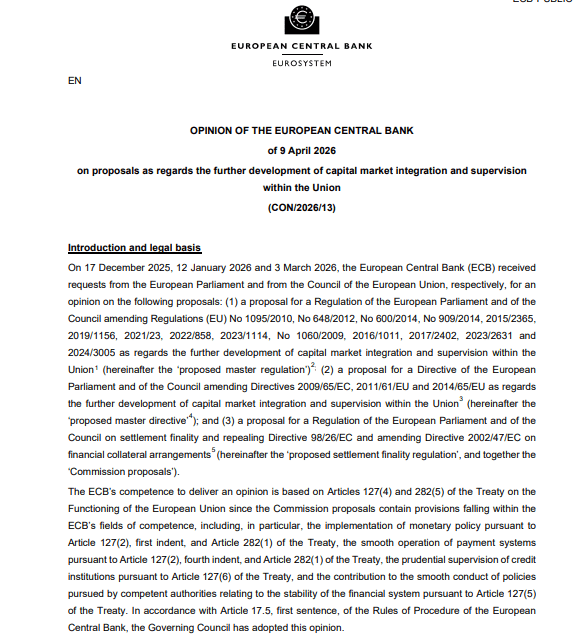
Under the proposed framework, supervision of systemically important cross-border entities, including large crypto asset service providers (CASPs), trading venues, clearinghouses, and securities depositories, would shift from national regulators to ESMA. This marks one of the most significant structural changes to crypto oversight since the Markets in Crypto-Assets (MiCA) framework became fully applicable at the end of 2024.
Phased Transition Recommended to Prevent Market Disruption
The ECB emphasized that ESMA must receive adequate staffing and funding to manage its expanded responsibilities effectively. It also recommended a gradual transition process from national authorities to reduce the risk of operational disruptions during implementation.
Resistance From Smaller EU Financial Hubs
Some EU member states, including Ireland, Luxembourg, and Malta, have expressed concerns about transferring authority to a centralized regulator. These countries host a significant number of crypto licensing activities, with major exchanges such as Coinbase securing authorization through Luxembourg, while OKX and Gemini obtained licenses via Malta. Kraken has similarly expanded its derivatives operations through licensing arrangements with the Central Bank of Ireland and a Cypriot MiFID entity.
The ECB also argued that large crypto firms could become systemically relevant, requiring unified supervision to prevent risks from spreading into the banking sector. Additionally, the central bank requested a non-voting seat on ESMA’s executive board to provide technical expertise on payment systems and monetary policy transmission.
Negotiations on the proposal will now continue between EU member states and the European Parliament, a process expected to last several months before any final regulatory changes are approved.
Disclaimer
This content is for informational purposes only and does not constitute financial, investment, or legal advice. Cryptocurrency trading involves risk and may result in financial loss