
Analysts Highlight Three Active Supply Vacuums Driving Ether’s Bullish Outlook
Ethereum’s native token, Ether (ETH), is facing one of the most constrained supply environments in its history — a dynamic that analysts say could set the stage for a major upward price breakout.
According to market data, nearly 40% of Ether’s total supply is now locked or removed from circulation, with institutional demand accelerating through newly launched spot ETFs, staking mechanisms, and digital asset treasuries (DATs). These three factors together form what analysts describe as “triple supply vacuums”, a rare condition where available liquidity for ETH continues to shrink even as global demand expands.
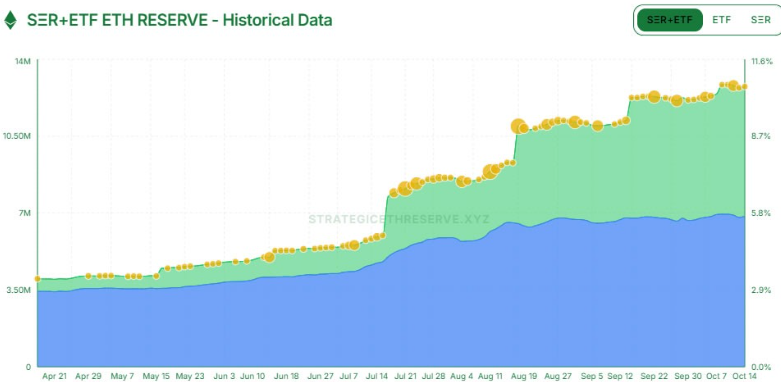
“Ethereum has never faced a cycle where all three vacuums were active at once,” said one market analyst, noting that DATs alone have accumulated 5.9 million ETH, valued at approximately $24 billion, or about 4.9% of total supply. These long-term institutional holdings are designed for yield generation rather than short-term trading, effectively reducing market float.
Meanwhile, U.S.-based Ether ETFs have absorbed around 6.8 million ETH, equivalent to 5.6% of circulating supply, despite current restrictions on staking within ETF structures. In parallel, the staking ecosystem has expanded to an all-time high of 35.7 million ETH, worth roughly $146 billion, or 30% of the entire supply. With exit queues exceeding 40 days, most of this capital remains temporarily illiquid, intensifying the scarcity narrative.
“When demand meets a shrinking supply like this, price doesn’t just rise — it goes nuclear,” said another market strategist, adding that ETF staking approval could further accelerate institutional inflows.
Some analysts project that Ether could reach between $8,000 and $10,000 in the current cycle if macro conditions remain supportive.
Additionally, nation-states may emerge as a new demand driver, as sovereign entities explore blockchain infrastructure and potential crypto reserves. The Kingdom of Bhutan’s integration of its national ID system on Ethereum is being viewed as a symbolic step toward broader governmental adoption.
With record institutional demand, rising staking participation, and limited liquid supply, Ethereum appears poised for a powerful continuation of its upward cycle.
Disclaimer
This content is for informational purposes only and does not constitute financial, investment, or legal advice. Cryptocurrency trading involves risk and may result in financial loss.