

Privacy advocates say scanning private messages risks encryption, trust, and digital sovereignty
As the European Union inches closer to a decision on the controversial “Chat Control” law, privacy experts are raising red flags about its impact on encryption and user trust. The proposal, formally known as the Regulation to Prevent and Combat Child Sexual Abuse, could compel platforms to scan private messages before encryption, creating what critics see as a backdoor into personal communications.
Encryption and Trust at Risk
The regulation has sparked alarm among privacy advocates who argue it undermines the EU’s own principles. “Giving an inherently corruptible entity nearly unlimited visibility into the private lives of individuals is incompatible with an honest value statement of digital privacy,” said Hans Rempel, CEO of blockchain infrastructure firm Diode.
Legal experts also question the law’s compatibility with Articles 7 and 8 of the EU Charter of Fundamental Rights, which guarantee confidentiality of communications and personal data protection. “Client-side scanning would enable monitoring even without suspicion of unlawful activity,” explained Elisenda Fabrega, general counsel at Brickken.
Push Toward Decentralized Alternatives
Critics warn that undermining encryption could erode public confidence in mainstream messaging platforms, driving adoption of decentralized, Web3-based solutions. “Encryption is not only a technical feature, it is a promise to users that their private communications will remain confidential,” Fabrega said.
Rempel added that Web3 offers a fundamentally different approach: “Web3’s privacy battle cry is ‘Not your keys, not your data.’ This is true self-custody for data, giving users sovereignty from cradle to grave.”
Such a shift, experts argue, could fragment Europe’s digital market, weakening the EU’s role in setting international privacy standards.
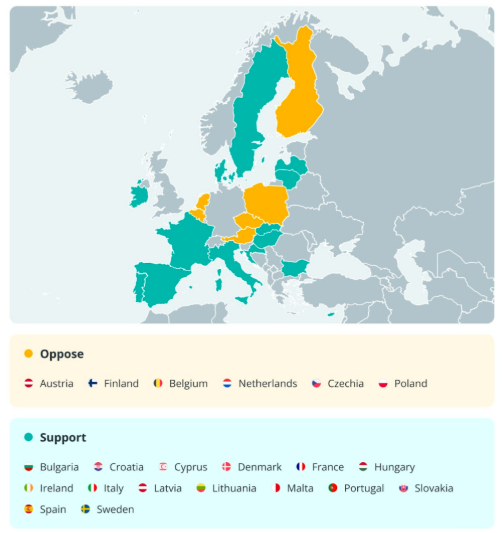
Currently, 15 EU countries support the law, but that falls short of the 65% population threshold required for passage. Germany holds the deciding vote, and its position will likely determine whether the legislation advances or collapses.
Disclaimer
This content is for informational purposes only and does not constitute financial, investment, or legal advice. Cryptocurrency trading involves risk and may result in financial loss.