

Regulatory Shift Seen as Major Win for Crypto Firms in U.S.

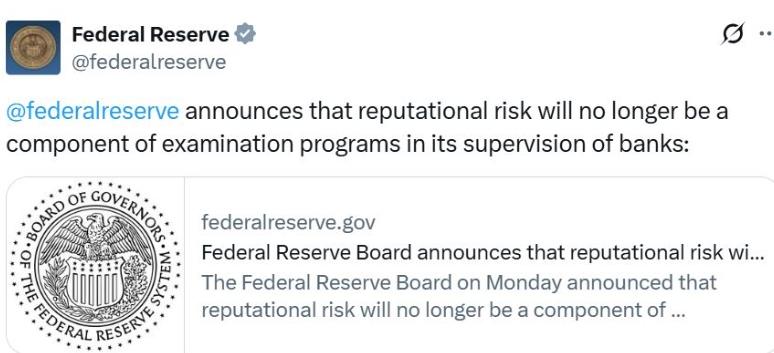
The U.S. Federal Reserve has announced a significant policy shift by eliminating “reputational risk” from its supervisory framework — a move widely seen as a direct response to longstanding complaints from the crypto industry. The decision addresses concerns that vague regulatory standards had been used to debank crypto and fintech firms under a practice critics called “Operation Chokepoint 2.0.”

Over 30 crypto and tech firms were denied banking access in the wake of crypto-friendly bank collapses in 2023.
What’s Changing?

In a statement released Monday, the Fed said it will remove references to reputational risk from its official guidance and replace them with more concrete criteria focused on financial risk. Supervisors will also undergo new training to ensure consistent application across all institutions.

The Federal Reserve clarified that banks must still maintain strong risk controls and comply with existing laws.

While banks can continue to consider reputational factors in internal risk management, the Fed will no longer use it as a regulatory enforcement standard. This shift aims to restore fairness and transparency, particularly for industries unfairly labeled as risky, including crypto businesses.
Industry Reaction: Applause and Caution

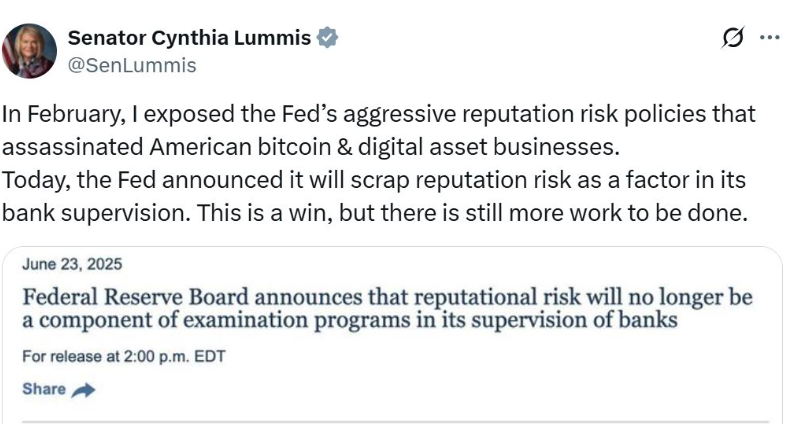
Senator Cynthia Lummis, a vocal pro-crypto lawmaker, called the update a long-overdue correction:
“Reputation risk policies assassinated American Bitcoin & digital asset businesses. This is a win, but more work remains,” she stated.

Rob Nichols, CEO of the American Bankers Association, welcomed the move, emphasizing that market forces and sound financial practices — not regulatory biases — should drive banking decisions.

“Banks should be free to engage with legal businesses, including crypto, based on financial due diligence,” Nichols said.

Critics Sound Alarm

However, some regulators and watchdogs argue that removing reputational risk could allow banks to ignore non-financial threats, such as ethical concerns or long-term trust issues, potentially weakening overall oversight.

A Broader Regulatory Trend

This is the latest sign that U.S. regulators are retreating from their hardline stance on crypto:

  • The FDIC said in March that banks can engage in crypto activities without prior approval.
  • The OCC confirmed in May that federally chartered banks may now offer crypto trading services and outsource digital asset functions.

This rollback may help rebuild bridges between U.S. banks and crypto companies, fostering financial innovation under clearer, more predictable rules.

Disclaimer

This content is for informational purposes only and does not constitute financial, investment, or legal advice. Cryptocurrency trading involves risk and may result in financial loss.

logo

blockto.io

info@blockto.io

Blockto.io Copyright © 2025, All rights reserved

News
Rates
Buy
More
We use cookies to personalize content and ads, provide social media features, and analyze our traffic. In accordance with GDPR/AVG and EU cookie regulations, data is processed only with your consent. We may share information about your use of our website with our social media, advertising, and analytics partners, and you can manage or withdraw your consent at any time. View more
Cookies settings
Accept
Privacy & Cookie policy
Privacy & Cookies policy
Cookie name Active

Privacy Policy

At BitxJournal.com, we respect your privacy and are committed to protecting your personal data. This Privacy Policy explains how we collect, process, store, and protect personal information in accordance with the General Data Protection Regulation (GDPR) and AVG (EU privacy legislation).

1. Data Controller

BitxJournal.com acts as the data controller for all personal data processed through this website.

2. Personal Data We Collect

We may collect and process the following categories of data:

Personal Data

  • Name and email address (when you subscribe to newsletters or contact us)

Technical & Usage Data

  • IP address, browser type, operating system

  • Device information

  • Pages visited, referral sources, and interaction data

This data is collected via cookies, log files, and analytics technologies.

3. Legal Basis for Processing

We process personal data only when a lawful basis exists, including:

  • Consent – when you explicitly agree (e.g., cookies, newsletter sign-up)

  • Legitimate interest – to operate, secure, and improve our website

  • Legal obligation – when required by applicable laws

You may withdraw your consent at any time.

4. Purpose of Data Processing

Your data is processed for the following purposes:

  • Operating and maintaining the website

  • Improving content, usability, and performance

  • Sending newsletters or updates (only with consent)

  • Analyzing traffic and user behavior

  • Responding to inquiries or support requests

5. Cookies & Consent Management

We use cookies and similar technologies in compliance with EU Cookie Law.

  • Non-essential cookies are placed only after explicit user consent

  • Users may accept, reject, or manage cookie preferences at any time

  • Consent can be withdrawn without affecting prior lawful processing

Detailed cookie information is available in our Cookie Settings panel.

6. Third-Party Data Processing

We may share limited data with trusted third-party service providers, including:

  • Analytics providers (e.g., Google Analytics)

  • Advertising partners (for personalized or non-personalized ads)

These third parties act as data processors and process data only under contractual obligations compliant with GDPR/AVG.

7. International Data Transfers

Where data is transferred outside the European Economic Area (EEA), we ensure appropriate safeguards are in place, such as Standard Contractual Clauses (SCCs) or equivalent legal mechanisms.

8. Data Retention

We retain personal data only for as long as necessary to fulfill the purposes outlined in this policy or as required by law.

9. Data Security

We implement appropriate technical and organizational security measures to protect personal data against unauthorized access, alteration, disclosure, or destruction.

10. Your GDPR Rights

Under GDPR/AVG, you have the right to:

  • Access your personal data

  • Rectify inaccurate or incomplete data

  • Request data erasure (“right to be forgotten”)

  • Restrict or object to processing

  • Data portability

  • Withdraw consent at any time

  • Lodge a complaint with a supervisory authority

11. Changes to This Privacy Policy

We reserve the right to update this Privacy Policy at any time. Any changes will be posted on this page with a revised effective date.

12. Contact Information

For privacy-related inquiries or GDPR requests, contact:

📧 Email: support@blockto.io
🌐 Website: https://blockto.io

Save settings
Cookies settings