
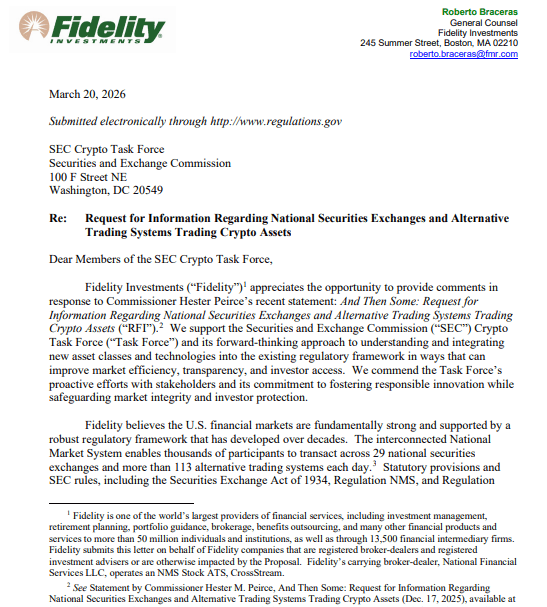
Fidelity Investments has urged US regulators to expand guidance allowing broker dealers to offer, custody and trade crypto assets through alternative trading systems. The firm emphasized that a clear regulatory framework is essential for supporting tokenized securities issued by third parties and enabling broader participation in blockchain-based markets.
In its response to regulators, Fidelity highlighted that tokenized instruments differ widely in their structure, legal rights and valuation methods. These assets can represent a range of real world investments, including equities, real estate, bonds and private credit. Some tokenization models provide indirect ownership in an underlying security, while others function similarly to securities-based swaps designed for qualified investors.
Bridging Centralized and Decentralized Trading Systems
Fidelity also recommended closing the regulatory gap between traditional centralized exchanges and decentralized finance platforms. The firm noted that decentralized systems operate without a central authority, making conventional reporting requirements difficult to meet. Updating reporting rules to reflect decentralized trading realities could reduce compliance burdens and encourage innovation.
Support for Distributed Ledger Use in Market Infrastructure
The company further suggested allowing broker dealers to use distributed ledger technology for alternative trading systems and recordkeeping processes. Regulators have recently signaled support for around-the-clock capital markets, and financial authorities maintain that tokenized securities must meet the same capital requirements as their underlying assets, regardless of the technology used.
Disclaimer
This content is for informational purposes only and does not constitute financial, investment, or legal advice. Cryptocurrency trading involves risk and may result in financial loss.