
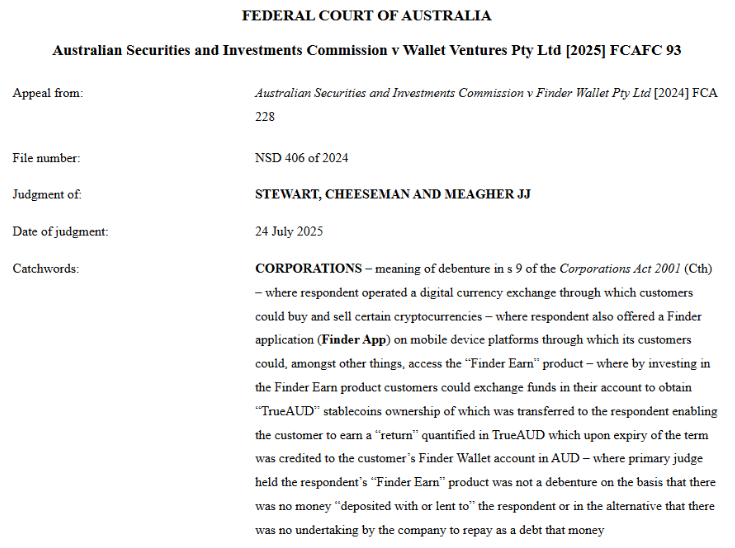
In a major win for Australia’s fintech and crypto sectors, the Federal Court of Australia has ruled that Finder.com’s Earn product is not a financial product, defeating a long-standing legal challenge from the Australian Securities and Investments Commission (ASIC).
Court Sides with Innovation in Three-Year Legal Dispute
The decision, delivered by Justices Stewart, Cheeseman, and Meagher on Thursday, upheld a previous judgment that Finder Wallet and its Earn product complied with financial laws. The court confirmed that Finder Earn did not constitute a debenture or other regulated financial instrument.
This ruling comes after ASIC’s appeal of a March 2025 decision was rejected—effectively closing a nearly three-year legal standoff that had broader implications for crypto regulation in the country.
What Was Finder Earn?
Finder Earn, which operated between February and November 2022, allowed users to convert Australian dollars into stablecoins (TrueAUD, or TAUD) and transfer them to the Finder Wallet in exchange for an annual yield between 4% and 6%.
The company clarified it returned all customer funds—over 500,000 TAUD (~$336,000 USD)—after discontinuing the product, reinforcing its commitment to compliance and transparency.
A Win for Australia’s Fintech Ecosystem
Finder called the ruling a milestone for innovation, stating that crypto-based financial services deserve fair, trusted pathways similar to traditional asset classes.
“This is a win not just for Finder, but for fintech in Australia,” said Fred Schebesta, Finder’s founder. “We built Finder Earn with transparency and integrity, consulting ASIC throughout the process.”
Schebesta emphasized that the case represented a situation where innovation moved faster than regulation, but still operated within legal boundaries.
He also hinted at new developments following the legal victory, teasing a “massive” project currently in the works.
Why It Matters
This ruling sets a critical precedent in how crypto yield products are viewed under Australian law, particularly in defining what constitutes a “financial product.” It also signals a more balanced regulatory approach for crypto platforms seeking to innovate responsibly.
With this case closed, the decision may empower other Australian fintechs to continue developing staking, yield, and NFT products under clearer legal conditions.
Disclaimer
This content is for informational purposes only and does not constitute financial, investment, or legal advice. Cryptocurrency trading involves risk and may result in financial loss.