

The debate over how to regulate cryptocurrencies in the United States intensified this week as former SEC Chair Gary Gensler publicly defended his enforcement-heavy approach, even as the agency under new leadership signals a dramatic shift in direction.

Gensler Stands by Enforcement Approach

In a rare interview since stepping down in January, Gensler told CNBC that he had “no regrets” about the SEC’s aggressive stance toward crypto during his tenure. He argued that digital assets remain “highly speculative and very risky”, stressing that the regulator’s actions were necessary to protect investors.

“We were consistently trying to ensure investor protection. And in the midst of it, we had a lot of fraudsters — look at Sam Bankman-Fried, and he wasn’t alone,” Gensler said.
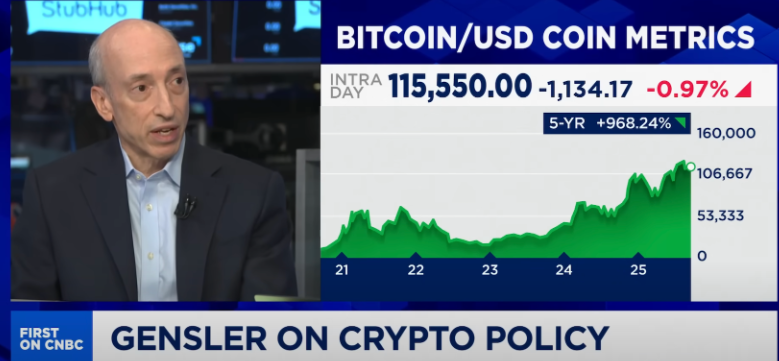
Former SEC Chair Gary Gensler in a Wednesday interview. : CNBC

Gensler, who led the SEC from 2021 to early 2025, oversaw lawsuits and enforcement actions against several major crypto firms. Critics accused him of pursuing “regulation by enforcement,” but Gensler maintained that his policies were justified by the wave of collapses and frauds that hit the sector.

Trump Administration Pushes SEC Sea Change

Gensler’s departure coincided with President Donald Trump’s inauguration on Jan. 20, 2025, fulfilling Trump’s campaign pledge to remove him “on day one.” Since then, the SEC — now led by Chair Paul Atkins — has reversed many of Gensler’s measures.

The Trump-aligned SEC has:

  • Dropped several lawsuits against major crypto companies.
  • Declared that “very few tokens are securities”, signaling a lighter regulatory stance.
  • Streamlined approval standards for crypto exchange-traded funds (ETFs).

These moves have been welcomed by many in the digital asset industry, which long argued that Gensler’s approach stifled innovation.

Corporate Reporting Rules on the Line

Perhaps the most significant proposed shift goes beyond crypto. Trump suggested eliminating quarterly reporting requirements for U.S. companies, reducing them to twice a year. Atkins confirmed on Friday that the SEC is “considering” the proposal.

Gensler, however, warned that such a change could reduce transparency and increase volatility:

“If we go to only twice-a-year reporting, the markets will be a bit more volatile.”

The SEC’s evolving stance highlights the stark contrast between Gensler’s strict oversight and the Trump administration’s pro-market approach. For investors, the coming months could redefine the balance between regulatory safeguards and market freedom in both crypto and traditional finance.

Disclaimer

This content is for informational purposes only and does not constitute financial, investment, or legal advice. Cryptocurrency trading involves risk and may result in financial loss.

logo

blockto.io

info@blockto.io

Blockto.io Copyright © 2025, All rights reserved

News
Rates
Buy
More
We use cookies to personalize content and ads, provide social media features, and analyze our traffic. In accordance with GDPR/AVG and EU cookie regulations, data is processed only with your consent. We may share information about your use of our website with our social media, advertising, and analytics partners, and you can manage or withdraw your consent at any time. View more
Cookies settings
Accept
Privacy & Cookie policy
Privacy & Cookies policy
Cookie name Active

Privacy Policy

At BitxJournal.com, we respect your privacy and are committed to protecting your personal data. This Privacy Policy explains how we collect, process, store, and protect personal information in accordance with the General Data Protection Regulation (GDPR) and AVG (EU privacy legislation).

1. Data Controller

BitxJournal.com acts as the data controller for all personal data processed through this website.

2. Personal Data We Collect

We may collect and process the following categories of data:

Personal Data

  • Name and email address (when you subscribe to newsletters or contact us)

Technical & Usage Data

  • IP address, browser type, operating system

  • Device information

  • Pages visited, referral sources, and interaction data

This data is collected via cookies, log files, and analytics technologies.

3. Legal Basis for Processing

We process personal data only when a lawful basis exists, including:

  • Consent – when you explicitly agree (e.g., cookies, newsletter sign-up)

  • Legitimate interest – to operate, secure, and improve our website

  • Legal obligation – when required by applicable laws

You may withdraw your consent at any time.

4. Purpose of Data Processing

Your data is processed for the following purposes:

  • Operating and maintaining the website

  • Improving content, usability, and performance

  • Sending newsletters or updates (only with consent)

  • Analyzing traffic and user behavior

  • Responding to inquiries or support requests

5. Cookies & Consent Management

We use cookies and similar technologies in compliance with EU Cookie Law.

  • Non-essential cookies are placed only after explicit user consent

  • Users may accept, reject, or manage cookie preferences at any time

  • Consent can be withdrawn without affecting prior lawful processing

Detailed cookie information is available in our Cookie Settings panel.

6. Third-Party Data Processing

We may share limited data with trusted third-party service providers, including:

  • Analytics providers (e.g., Google Analytics)

  • Advertising partners (for personalized or non-personalized ads)

These third parties act as data processors and process data only under contractual obligations compliant with GDPR/AVG.

7. International Data Transfers

Where data is transferred outside the European Economic Area (EEA), we ensure appropriate safeguards are in place, such as Standard Contractual Clauses (SCCs) or equivalent legal mechanisms.

8. Data Retention

We retain personal data only for as long as necessary to fulfill the purposes outlined in this policy or as required by law.

9. Data Security

We implement appropriate technical and organizational security measures to protect personal data against unauthorized access, alteration, disclosure, or destruction.

10. Your GDPR Rights

Under GDPR/AVG, you have the right to:

  • Access your personal data

  • Rectify inaccurate or incomplete data

  • Request data erasure (“right to be forgotten”)

  • Restrict or object to processing

  • Data portability

  • Withdraw consent at any time

  • Lodge a complaint with a supervisory authority

11. Changes to This Privacy Policy

We reserve the right to update this Privacy Policy at any time. Any changes will be posted on this page with a revised effective date.

12. Contact Information

For privacy-related inquiries or GDPR requests, contact:

📧 Email: support@blockto.io
🌐 Website: https://blockto.io

Save settings
Cookies settings