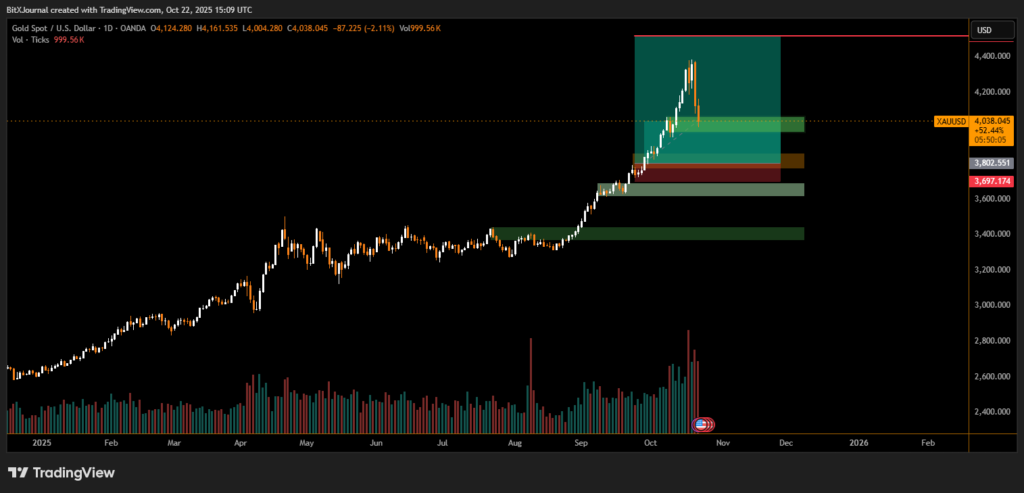
The precious metal’s steepest two-day fall in over a decade rattles investors, but Bitcoin’s resilience offers a sharp contrast.
Gold — long regarded as the ultimate store of value — has just suffered one of its worst collapses in modern history. In a stunning 24-hour downturn, the gold market erased $2.5 trillion in capitalization, a figure that exceeds Bitcoin’s entire market value.
According to data from The Kobeissi Letter, the 8% plunge marks gold’s largest two-day drop since 2013, shattering investor confidence in the metal often seen as a hedge against inflation and economic uncertainty. The sell-off followed a period of speculative exuberance after gold’s 60% rally in 2022, leaving even long-term holders reeling.
“Gold is giving us a lesson in statistics,” said Alexander Stahel, a Swiss resources investor, noting that such a decline is statistically expected “only once every 240,000 trading days.”
Gold is giving us a lesson in statistics. Today's −5.7% move is rare; a 4.46-sigma move.
In a “normal” world, that’s once every 240,000 trading days. In reality −4.67% to −6.00% occurred 34 times since 1971, i.e. in 13,088 trading days (0.26% = 1 in 385 days).
Analysts point to FOMO-driven speculation as a key factor behind the meltdown. As more investors rushed into physical gold, equities, and tokenized gold products, momentum grew unsustainably. Stahel noted that profit-taking and weak hands triggered a wave of sell orders once sentiment flipped.
“FOMO caused the latest leg up. Now, profit-taking and weak hands got shaken out,” he said, adding that statistically, “calmer days may be ahead.”
Despite its reputation as a stable asset, the scale of gold’s market value loss — equivalent to 55% of the total crypto market cap — has led analysts to question whether the metal can still be called a “safe haven.”
While gold tumbled, Bitcoin (BTC) traded around $108,700, slipping just 0.8% intraday after a mild correction from its $114,000 peak. Historically criticized for its volatility, Bitcoin’s relatively moderate move during gold’s collapse has drawn renewed attention from macro investors.
Meanwhile, data shows Bitcoin ETFs saw $142 million in inflows during the same period, indicating investors may be viewing BTC as a credible alternative store of value amid gold’s turmoil.
Market Sentiment: Fear Creeps Back
The Crypto Fear & Greed Index has slipped into “Extreme Fear” territory — its lowest level since 2022 — suggesting market participants remain cautious despite inflows into Bitcoin. Still, analysts from Deutsche Bank maintain that both gold and Bitcoin share macroeconomic parallels, with BTC potentially emerging as a “digital complement” rather than a competitor.
The Crypto Fear & Greed Index
“Gold’s correction reminds us that even traditional safe-havens can be volatile. Bitcoin, however, offers scarcity and transparency that traditional assets can’t,” one market strategist noted.
In short: gold’s $2.5 trillion wipeout has shaken confidence in traditional hedges — and for the first time, Bitcoin looks less like a risk asset and more like the resilient refuge investors hoped gold would be.
Disclaimer
This content is for informational purposes only and does not constitute financial, investment, or legal advice. Cryptocurrency trading involves risk and may result in financial loss.
We use cookies to personalize content and ads, provide social media features, and analyze our traffic. In accordance with GDPR/AVG and EU cookie regulations, data is processed only with your consent. We may share information about your use of our website with our social media, advertising, and analytics partners, and you can manage or withdraw your consent at any time. View more
Cookies settings
Accept
Privacy & Cookie policy
Privacy & Cookies policy
Cookies list
Cookie name
Active
Privacy Policy
At BitxJournal.com, we respect your privacy and are committed to protecting your personal data. This Privacy Policy explains how we collect, process, store, and protect personal information in accordance with the General Data Protection Regulation (GDPR) and AVG (EU privacy legislation).
1. Data Controller
BitxJournal.com acts as the data controller for all personal data processed through this website.
2. Personal Data We Collect
We may collect and process the following categories of data:
Personal Data
Name and email address (when you subscribe to newsletters or contact us)
Technical & Usage Data
IP address, browser type, operating system
Device information
Pages visited, referral sources, and interaction data
This data is collected via cookies, log files, and analytics technologies.
3. Legal Basis for Processing
We process personal data only when a lawful basis exists, including:
Consent – when you explicitly agree (e.g., cookies, newsletter sign-up)
Legitimate interest – to operate, secure, and improve our website
Legal obligation – when required by applicable laws
You may withdraw your consent at any time.
4. Purpose of Data Processing
Your data is processed for the following purposes:
Operating and maintaining the website
Improving content, usability, and performance
Sending newsletters or updates (only with consent)
Analyzing traffic and user behavior
Responding to inquiries or support requests
5. Cookies & Consent Management
We use cookies and similar technologies in compliance with EU Cookie Law.
Non-essential cookies are placed only after explicit user consent
Users may accept, reject, or manage cookie preferences at any time
Consent can be withdrawn without affecting prior lawful processing
Detailed cookie information is available in our Cookie Settings panel.
6. Third-Party Data Processing
We may share limited data with trusted third-party service providers, including:
Analytics providers (e.g., Google Analytics)
Advertising partners (for personalized or non-personalized ads)
These third parties act as data processors and process data only under contractual obligations compliant with GDPR/AVG.
7. International Data Transfers
Where data is transferred outside the European Economic Area (EEA), we ensure appropriate safeguards are in place, such as Standard Contractual Clauses (SCCs) or equivalent legal mechanisms.
8. Data Retention
We retain personal data only for as long as necessary to fulfill the purposes outlined in this policy or as required by law.
9. Data Security
We implement appropriate technical and organizational security measures to protect personal data against unauthorized access, alteration, disclosure, or destruction.
10. Your GDPR Rights
Under GDPR/AVG, you have the right to:
Access your personal data
Rectify inaccurate or incomplete data
Request data erasure (“right to be forgotten”)
Restrict or object to processing
Data portability
Withdraw consent at any time
Lodge a complaint with a supervisory authority
11. Changes to This Privacy Policy
We reserve the right to update this Privacy Policy at any time. Any changes will be posted on this page with a revised effective date.
12. Contact Information
For privacy-related inquiries or GDPR requests, contact: