

The tokenized gold market is expanding alongside renewed demand for physical bullion, underscoring a broader shift toward safe-haven assets as confidence in the US dollar weakens. Rising geopolitical tensions, trade uncertainty, and currency risk are pushing investors toward assets viewed as long-term stores of value.
Recent data shows that tokenized gold is no longer a niche segment, but an increasingly relevant part of the global gold market.
Tether Gold Dominates the Tokenized Gold Market
Tether confirmed that its Tether Gold (XAUt) token now represents more than half of the global gold-backed stablecoin market, with a total value exceeding $2.2 billion. By the end of the fourth quarter, 520,089 XAUt tokens were in circulation, each backed one-to-one by physical gold reserves.
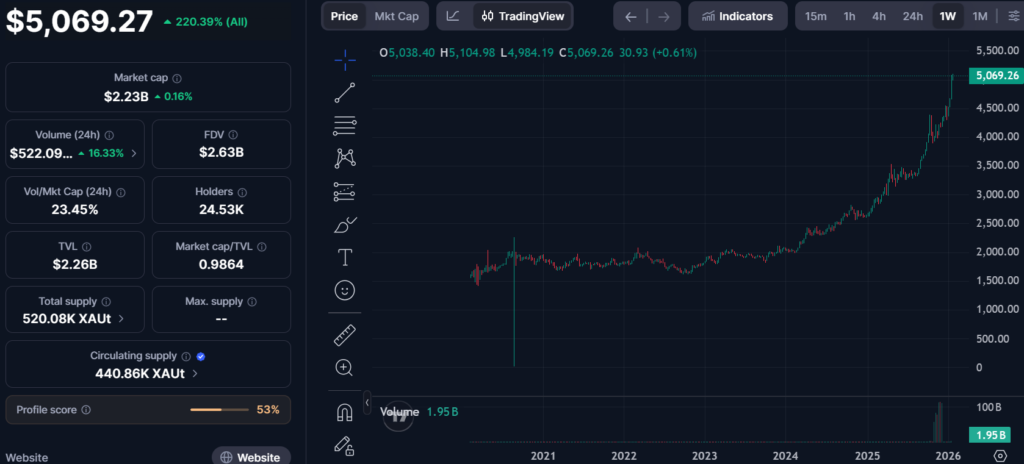
The scale of these holdings places the underlying gold vehicle alongside mid-sized sovereign gold holders, highlighting how digital gold products are beginning to mirror traditional bullion markets.
The update comes as Comex gold surpassed $5,000 per troy ounce for the first time, extending a year-to-date gain of roughly 17%. At the same time, the US Dollar Index (DXY) has continued its decline, falling more than 9% last year and reaching its lowest level since September this month.
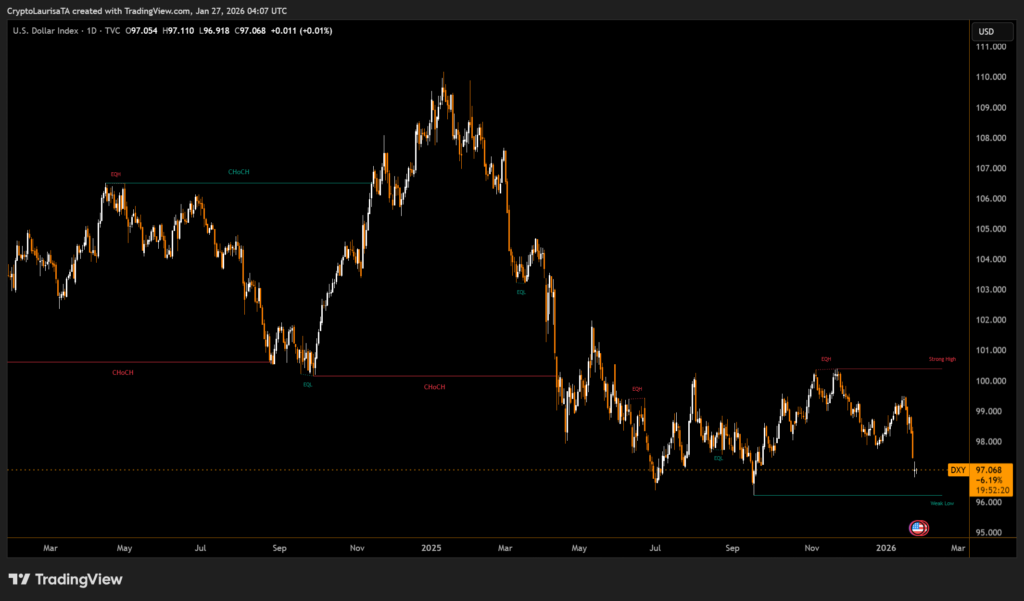
Central Banks Drive Long-Term Gold Demand
Central banks have been key drivers of the trend, purchasing 220 tonnes of gold in the third quarter of 2025 alone, according to industry data. This steady accumulation reflects efforts to reduce reliance on dollar-denominated assets.
While Bitcoin has been promoted as a hedge against currency debasement, it has yet to attract the consistent, long-term flows seen in gold, leaving bullion — both physical and digital — as the preferred defensive asset.
Disclaimer
This content is for informational purposes only and does not constitute financial, investment, or legal advice. Cryptocurrency trading involves risk and may result in financial loss.