

In a sweeping move that has sent shockwaves through the crypto community, Hungary has officially criminalized unauthorized cryptocurrency trading, with new legislation that went into effect on July 1, 2025. The updated Hungarian Criminal Code introduces prison penalties for both users and operators of unlicensed crypto services.
Prison Sentences for Using Unauthorized Crypto Exchanges
The revised legal framework now imposes up to two years in prison for individuals who trade using unauthorized crypto exchanges. The severity of penalties increases with the value of the transactions:
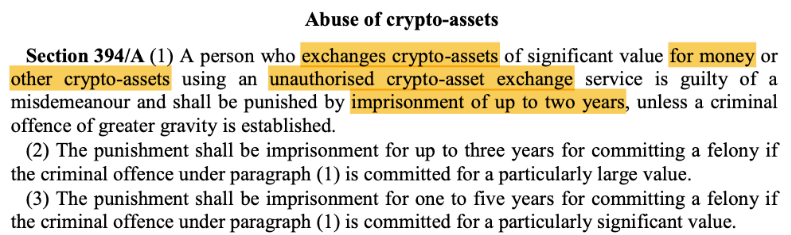
- Trading between 5 million and 50 million forints ($14,600 to $145,950) may result in up to 2 years imprisonment
- Offenses involving 50 million to 500 million forints ($145,950 to $1.46 million) carry up to 3 years
- Transactions exceeding 500 million forints ($1.46 million) can lead to up to 5 years in prison
This legislation marks the first time Hungary has explicitly classified unauthorized crypto activity as a criminal offense.
Harsh Penalties for Unlicensed Crypto Service Providers
The law doesn’t just target users—it also cracks down on unlicensed crypto service providers. Those found offering exchange or trading services without official authorization now face:
- Up to 3 years imprisonment for offenses involving values under 50 million forints
- Up to 5 years for violations up to 500 million forints
- Up to 8 years if the value of unauthorized trades exceeds 500 million forints
This new category, labeled “abuse of crypto-assets,” sets a strong precedent within the EU for stricter digital asset enforcement.
Confusion Among Crypto Companies Amid Unclear Compliance Path
Hungarian crypto businesses are currently operating in a legal gray area, as the Supervisory Authority for Regulatory Affairs (SZTFH) has 60 days to outline how platforms can comply—but has yet to issue any guidance.
This delay in clarity has left platforms unsure how to continue operations legally.
Revolut Briefly Suspends Crypto Services in Hungary
In response to the new legislation, UK-based fintech firm Revolut temporarily halted all crypto services for Hungarian users earlier this month. A notice on its Hungarian site cited “recently introduced Hungarian legislation” as the cause.
While crypto withdrawals have since been reinstated, the company has confirmed that its EU entity is pursuing full regulatory approval to continue crypto services legally under the new regime.
In summary, Hungary’s updated criminal code represents one of the strictest crypto enforcement laws in the European region. With jail time now a real possibility for both users and providers of unauthorized crypto services, the law sets a precedent that could influence policy across the EU. As regulatory frameworks evolve, crypto investors in Hungary and beyond will need to navigate increasingly complex legal landscapes.
Disclaimer
This content is for informational purposes only and does not constitute financial, investment, or legal advice. Cryptocurrency trading involves risk and may result in financial loss.