

ICP/USDT Daily Structure Points to Heavy Supply Pressure After Sudden Pullback
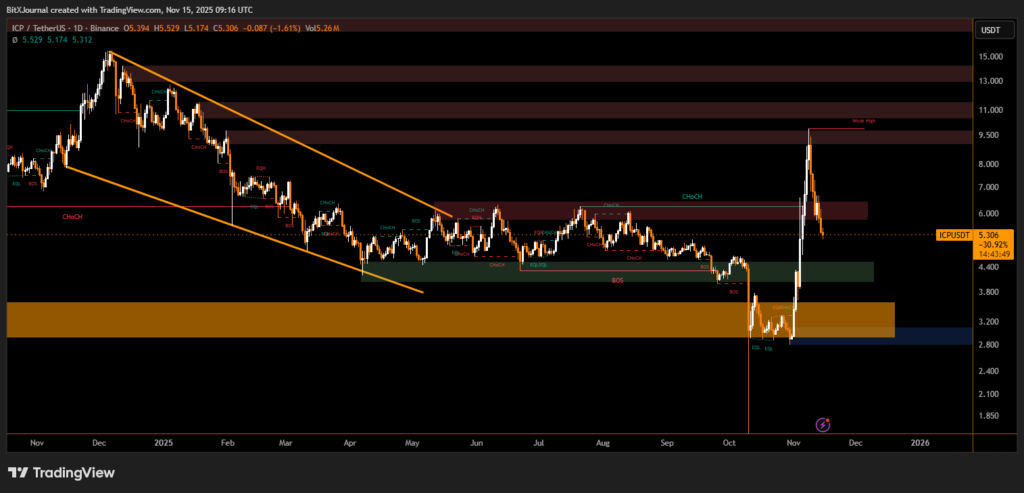
Internet Computer is facing renewed selling pressure after a swift correction that erased roughly 4% in daily trading. The latest ICP/USDT technical structure shows the market reacting to a major supply zone that has capped upward momentum. Analysts say the recent decline is part of a larger pattern defined by a long-term downtrend, followed by a short-lived breakout that failed to secure higher support.
Heavy Supply Zones Trigger Rejection
The chart highlights a wide supply cluster between $9.00 and $13.00, marked by multiple historical reactions. The recent vertical surge into this zone resulted in an immediate rejection, with price dropping back toward mid-range levels.
This rejection underscores the dominance of sell-side liquidity layered across the upper chart structure.
BitXJournal market technician explains, “Every time ICP reaches anywhere near the $10 region, the order flow flips sharply. This signals that large participants still view that zone as a distribution area rather than a breakout opportunity.”
Mid-Range Structure Remains Unresolved
Before the sudden spike, ICP spent months consolidating between $3.00 and $4.40, forming a series of Breaks of Structure (BOS) and Change of Character (ChoCH) signals. This long accumulation band remains a key battlefield, particularly as price shifts back toward it.
BitXJournal technical analyst notes, “The breakout looked promising, but it lacked follow-through. Without a strong base forming above the green mid-range area, the rally was vulnerable to a swift reversal.”
Demand Zone Stability in Focus
The chart shows two lower demand areas: a broad zone near $3.20–$3.60 and a deeper liquidity region around $2.70–$2.90. These acted as launch points during the recent rally, and the market is now watching to see whether they hold again.
With ICP trading near $5.30 after the 4% drop, the market is once again reacting to strong overhead supply. Whether the asset can stabilize in the current region—or must revisit the lower demand zones—will likely define its next major move. Traders are closely monitoring structural signals as volatility begins to expand again.
Disclaimer
This content is for informational purposes only and does not constitute financial, investment, or legal advice. Cryptocurrency trading involves risk and may result in financial loss.