

In a bold regulatory shift, Japan’s Financial Services Agency (FSA) has proposed reclassifying cryptocurrencies as financial products, a move that could transform the country’s digital asset market.

The proposed changes would bring crypto under the Financial Instruments and Exchange Act (FIEA), the same legal framework that governs securities and traditional financial instruments like stocks and bonds.

Flat 20% Tax and ETFs on the Horizon

One of the most impactful elements of the proposal is a plan to introduce a flat 20% capital gains tax on crypto profits—replacing the current progressive tax system that reaches up to 55%.

This could dramatically lower the tax burden for active traders and long-term holders, making Japan a more attractive environment for retail and institutional investors.

The reclassification would also clear a path for the approval of crypto exchange-traded funds (ETFs), similar to those recently approved in the U.S., where institutional interest is surging.


Part of Japan’s “New Capitalism” Strategy

This regulatory push aligns with Japan’s broader “New Capitalism” economic initiative, which aims to stimulate growth through investment-friendly reforms and financial modernization.

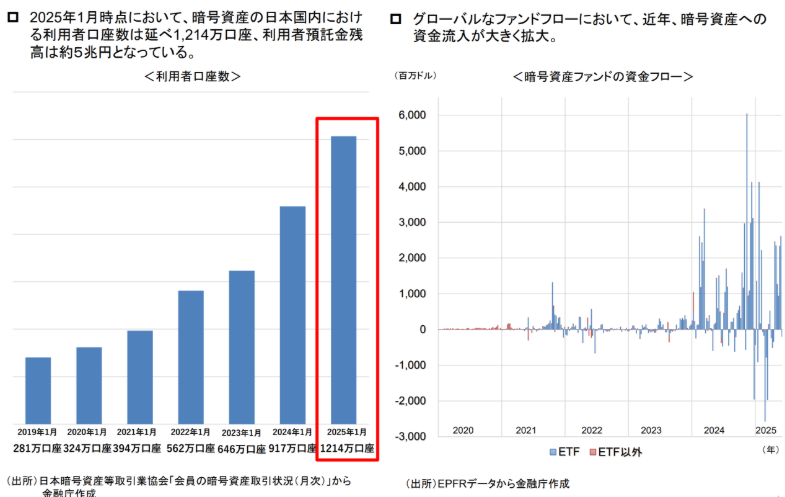
The FSA emphasized that crypto assets are now widely used and owned in Japan, with:

  • Over 12 million active domestic crypto accounts
  • More than ¥5 trillion (~$34 billion) in digital assets held on local platforms
  • Crypto ownership outpacing traditional investments like FX and bonds among younger, tech-savvy investors

Institutional Momentum Accelerates Globally

The FSA also cited the rapid rise in institutional crypto engagement, noting that over 1,200 financial institutions—including US pension funds and Goldman Sachs—now hold US-listed spot Bitcoin ETFs.

Japanese regulators see an opportunity to replicate this growth locally by allowing similar investment vehicles under the FIEA framework.


Stablecoin Expansion Supports Broader Tokenization Goals

Japan is also expanding its regulatory support for stablecoins. In April 2025, major firms including SMBC, Ava Labs, Fireblocks, and TIS Inc. signed an MoU to explore stablecoin issuance pegged to the yen and U.S. dollar.

Additionally:

  • In March, SBI VC Trade received Japan’s first license to handle stablecoins
  • The firm is preparing to support Circle’s USDC, aiming to facilitate real-world asset (RWA) settlements like stocks and real estate via tokenization

Conclusion: Japan Aims to Become a Crypto Powerhouse

By redefining crypto as a financial product and lowering tax burdens, Japan is signaling a clear intent to become a global hub for digital asset innovation.

With supportive regulation, ETF pathways, and strong institutional momentum, Japan is well-positioned to lead the next wave of crypto adoption in Asia.

Disclaimer

This content is for informational purposes only and does not constitute financial, investment, or legal advice. Cryptocurrency trading involves risk and may result in financial loss.

logo

blockto.io

info@blockto.io

Blockto.io Copyright © 2025, All rights reserved

News
Rates
Buy
More
We use cookies to personalize content and ads, provide social media features, and analyze our traffic. In accordance with GDPR/AVG and EU cookie regulations, data is processed only with your consent. We may share information about your use of our website with our social media, advertising, and analytics partners, and you can manage or withdraw your consent at any time. View more
Cookies settings
Accept
Privacy & Cookie policy
Privacy & Cookies policy
Cookie name Active

Privacy Policy

At BitxJournal.com, we respect your privacy and are committed to protecting your personal data. This Privacy Policy explains how we collect, process, store, and protect personal information in accordance with the General Data Protection Regulation (GDPR) and AVG (EU privacy legislation).

1. Data Controller

BitxJournal.com acts as the data controller for all personal data processed through this website.

2. Personal Data We Collect

We may collect and process the following categories of data:

Personal Data

  • Name and email address (when you subscribe to newsletters or contact us)

Technical & Usage Data

  • IP address, browser type, operating system

  • Device information

  • Pages visited, referral sources, and interaction data

This data is collected via cookies, log files, and analytics technologies.

3. Legal Basis for Processing

We process personal data only when a lawful basis exists, including:

  • Consent – when you explicitly agree (e.g., cookies, newsletter sign-up)

  • Legitimate interest – to operate, secure, and improve our website

  • Legal obligation – when required by applicable laws

You may withdraw your consent at any time.

4. Purpose of Data Processing

Your data is processed for the following purposes:

  • Operating and maintaining the website

  • Improving content, usability, and performance

  • Sending newsletters or updates (only with consent)

  • Analyzing traffic and user behavior

  • Responding to inquiries or support requests

5. Cookies & Consent Management

We use cookies and similar technologies in compliance with EU Cookie Law.

  • Non-essential cookies are placed only after explicit user consent

  • Users may accept, reject, or manage cookie preferences at any time

  • Consent can be withdrawn without affecting prior lawful processing

Detailed cookie information is available in our Cookie Settings panel.

6. Third-Party Data Processing

We may share limited data with trusted third-party service providers, including:

  • Analytics providers (e.g., Google Analytics)

  • Advertising partners (for personalized or non-personalized ads)

These third parties act as data processors and process data only under contractual obligations compliant with GDPR/AVG.

7. International Data Transfers

Where data is transferred outside the European Economic Area (EEA), we ensure appropriate safeguards are in place, such as Standard Contractual Clauses (SCCs) or equivalent legal mechanisms.

8. Data Retention

We retain personal data only for as long as necessary to fulfill the purposes outlined in this policy or as required by law.

9. Data Security

We implement appropriate technical and organizational security measures to protect personal data against unauthorized access, alteration, disclosure, or destruction.

10. Your GDPR Rights

Under GDPR/AVG, you have the right to:

  • Access your personal data

  • Rectify inaccurate or incomplete data

  • Request data erasure (“right to be forgotten”)

  • Restrict or object to processing

  • Data portability

  • Withdraw consent at any time

  • Lodge a complaint with a supervisory authority

11. Changes to This Privacy Policy

We reserve the right to update this Privacy Policy at any time. Any changes will be posted on this page with a revised effective date.

12. Contact Information

For privacy-related inquiries or GDPR requests, contact:

📧 Email: support@blockto.io
🌐 Website: https://blockto.io

Save settings
Cookies settings