

Japan has officially amended its Financial Instruments and Exchange Act to classify cryptocurrencies as financial instruments, marking a major shift in how digital assets are regulated in the country. The decision moves crypto beyond its previous classification under the Payment and Settlement Act and places it closer to traditional financial markets such as equities and securities.
Insider Trading Ban and Market Transparency Rules
Under the updated framework, insider trading involving cryptocurrencies is now explicitly prohibited. This includes buying or selling digital assets based on undisclosed or material non-public information. The law aims to improve market fairness and reduce risks linked to information asymmetry in crypto trading.
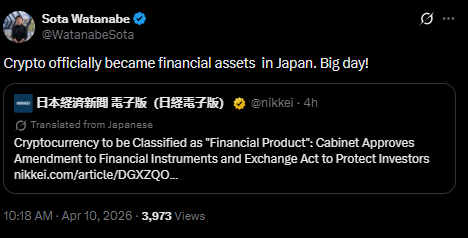
The amendment also introduces stricter disclosure obligations for cryptocurrency issuers. Companies involved in issuing digital assets will now be required to provide annual transparency reports, increasing regulatory oversight and investor protection standards. Authorities have also strengthened penalties for unregistered exchanges operating in the market.
Japan’s Shift Toward Institutional Crypto Integration
Japan’s Financial Services Agency previously regulated crypto mainly as a payment tool, but rising institutional participation has driven this reclassification. Officials have stated that the goal is to align crypto markets with traditional financial systems while maintaining transparency and investor safeguards. The country is also exploring crypto exchange-traded funds, signaling continued integration into mainstream financial infrastructure.
Disclaimer
This content is for informational purposes only and does not constitute financial, investment, or legal advice. Cryptocurrency trading involves risk and may result in financial loss.