

Bitcoin advocate Jimmy Song argued that the Bitcoin ecosystem requires a more “conservative” node client to preserve its monetary integrity and maintain decentralization.
Song is co founder of ProductionReady, a nonprofit initiative focused on funding open-source Bitcoin node software and educational efforts. He emphasized that their development philosophy favors minimal code changes unless there is overwhelming community agreement.
His core principle is simple: if developers are uncertain whether a modification improves Bitcoin as money, it should not be implemented. This cautious stance aims to prevent unintended technical changes that could weaken Bitcoin’s reliability as a decentralized financial system.
Restoring OP_Return Limits to Reduce Network Costs
One of ProductionReady’s goals is to restore the 83-byte limit on OP_Return, which controls how much arbitrary data can be included in transactions.
Song warned that increasing this limit significantly raises storage and bandwidth demands on node operators. If running a node becomes expensive, fewer individuals will operate them, increasing the risk of centralization.

Lower operating costs allow more users to run nodes independently, strengthening network security and reducing the chances of transaction fraud or collusion among large operators.
Bitcoin Core Changes Spark Community Backlash
The controversy began after the release of Bitcoin Core 30, which increased the OP_Return data limit from 83 bytes to 100,000 bytes. The update received strong criticism from many community members, with the proposal receiving roughly four times more downvotes than upvotes on its GitHub page.
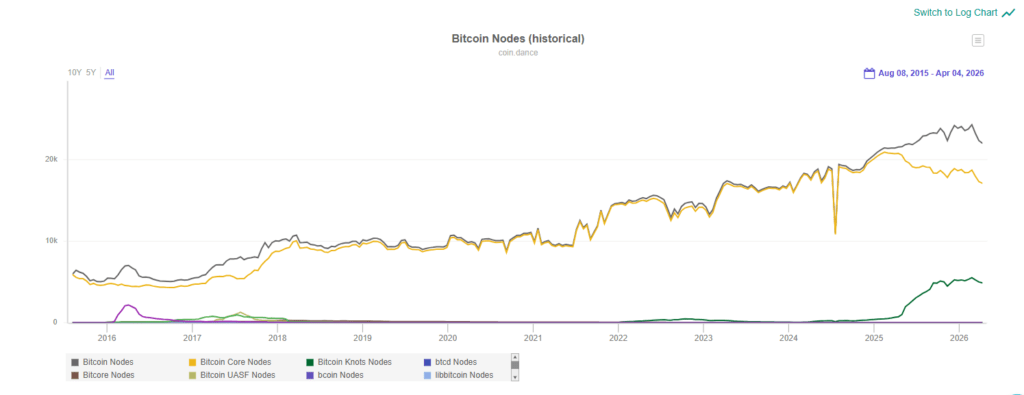
Following the update, many users migrated to alternative software such as Bitcoin Knots. Adoption of Bitcoin Knots surged dramatically, reaching 4,746 nodes—over 21.7% of the network—compared to roughly 1% usage in 2024.
Decentralization Remains the Core Goal
Song stressed that maximizing the number of independent node operators is essential for keeping Bitcoin decentralized and resistant to manipulation. A conservative development model, he argued, ensures that technical upgrades do not unintentionally undermine Bitcoin’s long-term monetary strength or accessibility for everyday users.
Disclaimer
This content is for informational purposes only and does not constitute financial, investment, or legal advice. Cryptocurrency trading involves risk and may result in financial loss.