
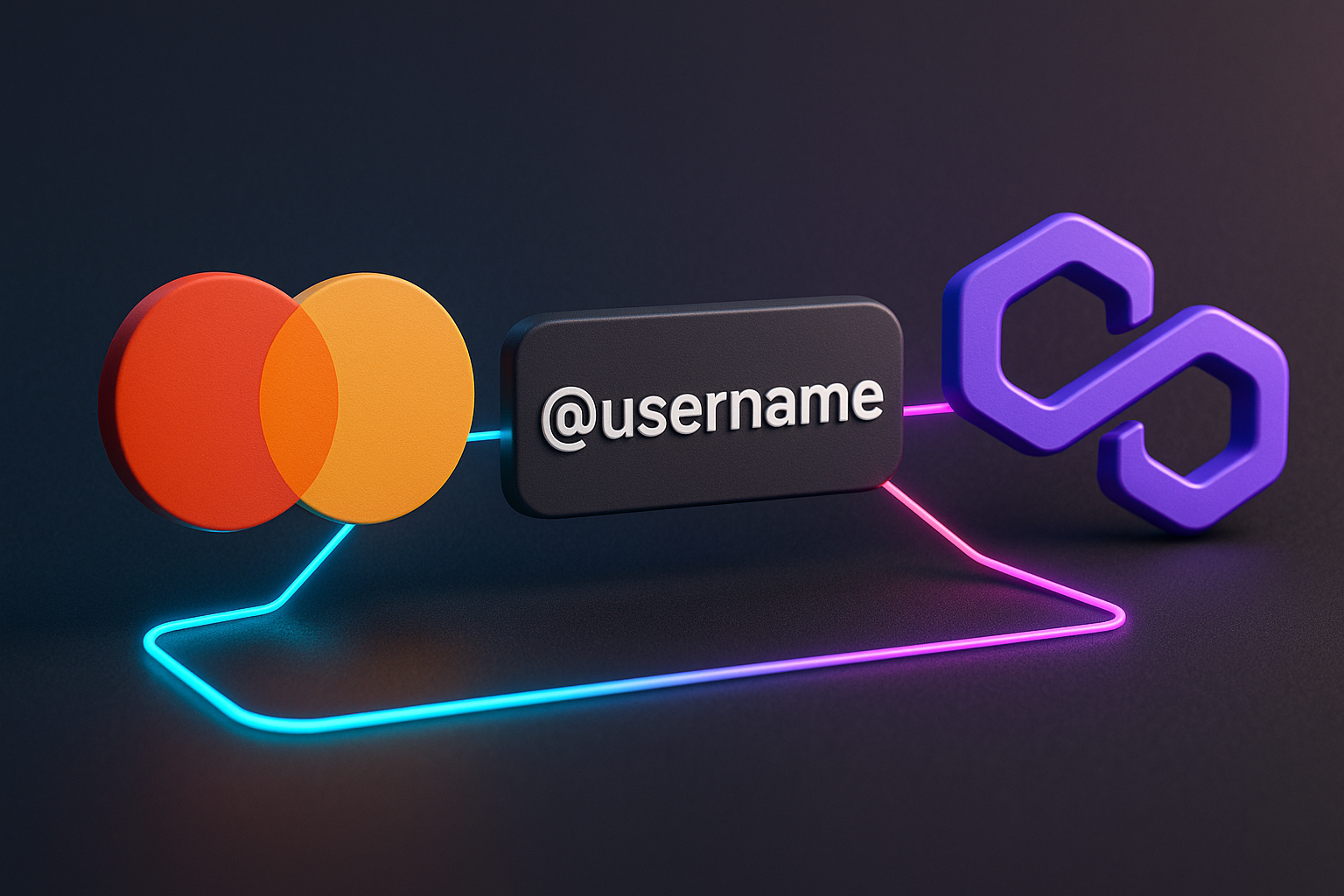
New system aims to make self-custody crypto payments safer and as intuitive as traditional finance

Mastercard is advancing its push into digital assets by introducing verified, human-readable aliases for self-custody wallets—removing the need for users to handle long, complex crypto addresses. The upgrade is launching with Polygon as the first supported blockchain, while Mercuryo will oversee verification and issue the user-friendly aliases.

Mastercard Brings Usernames to Self-Custody Wallets

Through the expanded Crypto Credential program, individuals will be able to send and receive cryptocurrency using simple, recognizable usernames instead of the typical hexadecimal strings. Once identity verification is completed by Mercuryo, users can bind an alias to their wallet or generate a soulbound token on Polygon that confirms the wallet belongs to a verified person.

A Mastercard executive described the change as a meaningful step toward safer digital transactions:
Streamlining wallet identifiers and adding verification layers helps build trust and reduces mistakes during token transfers.

Polygon Labs highlighted the simplicity the system brings, emphasizing that the partnership removes friction for everyday users.
This is the point where self-custody becomes truly accessible,” said a company representative, noting that reducing address-related errors has become a top priority for the ecosystem.

Enhancing Safety Without Sacrificing Control

The update is designed to mimic the familiar experience of traditional payment rails, while still preserving wallet sovereignty. Mercuryo, serving as the first issuer for the program, says demand for secure yet user-controlled crypto experiences has grown quickly, especially among users entering Web3 for the first time.

Mastercard has been steadily expanding its crypto footprint through 2024 and 2025, introducing partnerships such as:

  • A self-custody payments card built with MetaMask
  • Crypto-enabled debit cards launched with Kraken across Europe
  • Onchain purchase capabilities supported by multiple Web3 providers

Chainlink Integration Bolsters Mastercard’s Web3 Push

Earlier this year, Mastercard also teamed up with Chainlink to enable onchain crypto purchases for its global cardholder network. The system works with partners including Shift4, Swapper Finance, XSwap, and ZeroHash, with ZeroHash managing onchain liquidity for fiat-to-crypto swaps. Chainlink emphasized that the Swapper version is non-custodial, using account abstraction to provide a seamless experience for mainstream users.

By combining verified identities, human-readable aliases, and multi-chain support, Mastercard aims to eliminate one of the biggest frictions in crypto: the fear of sending funds to the wrong address. The program positions self-custody as safer and more practical, while deepening Mastercard’s presence in the evolving Web3 payments landscape.

Disclaimer

This content is for informational purposes only and does not constitute financial, investment, or legal advice. Cryptocurrency trading involves risk and may result in financial loss.

logo

blockto.io

info@blockto.io

Blockto.io Copyright © 2025, All rights reserved

News
Rates
Buy
More
We use cookies to personalize content and ads, provide social media features, and analyze our traffic. In accordance with GDPR/AVG and EU cookie regulations, data is processed only with your consent. We may share information about your use of our website with our social media, advertising, and analytics partners, and you can manage or withdraw your consent at any time. View more
Cookies settings
Accept
Privacy & Cookie policy
Privacy & Cookies policy
Cookie name Active

Privacy Policy

At BitxJournal.com, we respect your privacy and are committed to protecting your personal data. This Privacy Policy explains how we collect, process, store, and protect personal information in accordance with the General Data Protection Regulation (GDPR) and AVG (EU privacy legislation).

1. Data Controller

BitxJournal.com acts as the data controller for all personal data processed through this website.

2. Personal Data We Collect

We may collect and process the following categories of data:

Personal Data

  • Name and email address (when you subscribe to newsletters or contact us)

Technical & Usage Data

  • IP address, browser type, operating system

  • Device information

  • Pages visited, referral sources, and interaction data

This data is collected via cookies, log files, and analytics technologies.

3. Legal Basis for Processing

We process personal data only when a lawful basis exists, including:

  • Consent – when you explicitly agree (e.g., cookies, newsletter sign-up)

  • Legitimate interest – to operate, secure, and improve our website

  • Legal obligation – when required by applicable laws

You may withdraw your consent at any time.

4. Purpose of Data Processing

Your data is processed for the following purposes:

  • Operating and maintaining the website

  • Improving content, usability, and performance

  • Sending newsletters or updates (only with consent)

  • Analyzing traffic and user behavior

  • Responding to inquiries or support requests

5. Cookies & Consent Management

We use cookies and similar technologies in compliance with EU Cookie Law.

  • Non-essential cookies are placed only after explicit user consent

  • Users may accept, reject, or manage cookie preferences at any time

  • Consent can be withdrawn without affecting prior lawful processing

Detailed cookie information is available in our Cookie Settings panel.

6. Third-Party Data Processing

We may share limited data with trusted third-party service providers, including:

  • Analytics providers (e.g., Google Analytics)

  • Advertising partners (for personalized or non-personalized ads)

These third parties act as data processors and process data only under contractual obligations compliant with GDPR/AVG.

7. International Data Transfers

Where data is transferred outside the European Economic Area (EEA), we ensure appropriate safeguards are in place, such as Standard Contractual Clauses (SCCs) or equivalent legal mechanisms.

8. Data Retention

We retain personal data only for as long as necessary to fulfill the purposes outlined in this policy or as required by law.

9. Data Security

We implement appropriate technical and organizational security measures to protect personal data against unauthorized access, alteration, disclosure, or destruction.

10. Your GDPR Rights

Under GDPR/AVG, you have the right to:

  • Access your personal data

  • Rectify inaccurate or incomplete data

  • Request data erasure (“right to be forgotten”)

  • Restrict or object to processing

  • Data portability

  • Withdraw consent at any time

  • Lodge a complaint with a supervisory authority

11. Changes to This Privacy Policy

We reserve the right to update this Privacy Policy at any time. Any changes will be posted on this page with a revised effective date.

12. Contact Information

For privacy-related inquiries or GDPR requests, contact:

📧 Email: support@blockto.io
🌐 Website: https://blockto.io

Save settings
Cookies settings