





Photo: Illustrative
AI Agents Face Cost Challenges as Executives Question Workforce Replacement Claims
Prominent tech investors are questioning whether artificial intelligence agents are economically viable replacements for human workers, citing high operating costs and limited productivity gains.

Prominent tech investors are questioning whether artificial intelligence agents are economically viable replacements for human workers, citing high operating costs and limited productivity gains.
Investor Jason Calacanis said he is spending roughly $300 per day to run an AI agent powered by Anthropic’s Claude model, translating to an annualized cost of about $110,000. He noted that the system operates at only a fraction of its potential capacity, raising concerns about cost efficiency compared with hiring human employees.
Chamath Palihapitiya, chief executive of Social Capital, echoed those concerns, arguing that AI systems must be at least twice as productive as human workers to justify their expense. Token-based pricing models, where users pay for computing usage, can quickly escalate operational budgets.

The All-In Podcast
Debate Over AI Productivity and Long-Term Impact
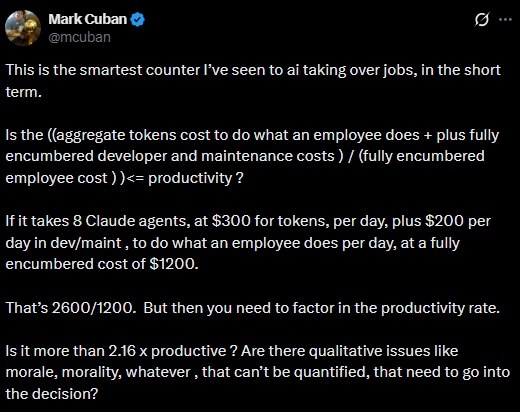
Billionaire entrepreneur Mark Cuban described the cost argument as one of the most compelling counterpoints to claims that AI will soon replace large segments of the workforce. He questioned whether AI agents deliver productivity gains sufficient to offset token fees, infrastructure costs, and qualitative factors such as workplace morale and ethics.
Despite concerns, AI adoption continues to expand across industries. Microsoft research has indicated that knowledge-based and customer service roles are among the most exposed to automation risk. Meanwhile, OpenAI recently introduced benchmarks to evaluate how AI models handle smart contract security, reflecting growing interest in economically significant AI deployment.
Disclaimer
This content is for informational purposes only and does not constitute financial, investment, or legal advice. Cryptocurrency trading involves risk and may result in financial loss.
Live market reaction
Disclaimer
This content is for informational purposes only and does not constitute financial, investment, or legal advice. Cryptocurrency trading involves risk and may result in financial loss.
Start trading
with BloFin today
Up to $500 sign-up bonus and zero-fee trading on your first 30 days.
Buy crypto nowⓘ You will be redirected to BloFin
About the author
8+ years covering crypto markets, macro, and geopolitics. Previously at Decrypt and CoinDesk. Focused on the intersection of digital assets and traditional finance.

BitMine Expands Ethereum Holdings With $238M Purchase, Nears 5% Supply Target
.jpeg&w=32&q=75) Laurisa ·
Laurisa · 
Bitcoin Price Outlook: Why BTC Could Move Toward $95K After $80K Recovery
 Tristan R. ·
Trump-Linked World Liberty Files Defamation Case Against Justin Sun Over WLFI Token Dispute
Laurisa ·