


Photo: Illustrative
Banks Challenge White House Findings on Stablecoin Yields and Deposit Risks
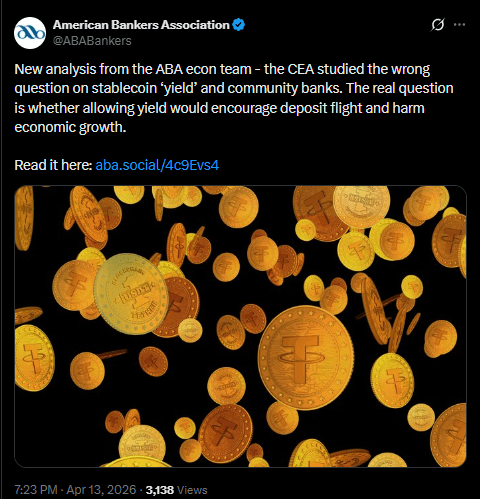
The American Bankers Association has pushed back against a recent report from the White House Council of Economic Advisers that suggested banning stablecoin yield payments would have only a minimal effect on the banking sector. The White House analysis estimated that prohibiting yields on stablecoins would increase bank lending by about $2.1 billion, representing just a 0.02% rise under baseline conditions.

The American Bankers Association has pushed back against a recent report from the White House Council of Economic Advisers that suggested banning stablecoin yield payments would have only a minimal effect on the banking sector. The White House analysis estimated that prohibiting yields on stablecoins would increase bank lending by about $2.1 billion, representing just a 0.02% rise under baseline conditions.
However, ABA chief economist Sayee Srinivasan and vice president Yikai Wang argued that the report focused on the wrong metric. They stressed that the primary concern is whether allowing stablecoin yields would encourage deposit outflows, particularly from smaller community banks that rely heavily on local funding.
Community Banks Warned of Rising Funding Costs
According to the ABA analysis, even if total deposits across the banking system remain stable, funds could shift from smaller institutions to larger banks offering more competitive rates. This movement could increase funding costs for community banks and reduce their ability to provide local lending services. Some smaller lenders may need to rely on higher-cost wholesale borrowing if deposit outflows accelerate.
Earlier estimates from the United States Department of the Treasury suggested that widespread adoption of stablecoins could lead to as much as $6.6 trillion in deposit outflows from traditional banks.
Stablecoin Rewards Seen as Competitive Threat to Traditional Banking
Despite raising concerns, banking researchers acknowledged that stablecoin rewards could be attractive to households and businesses seeking higher returns than traditional savings accounts. Industry voices such as Brian Armstrong have argued that stablecoin yields could push banks to offer more competitive interest rates.
The ABA represents major financial institutions including JPMorgan Chase, Goldman Sachs, and Citigroup, highlighting the broad industry attention on stablecoin yield policy discussions.
Disclaimer
This content is for informational purposes only and does not constitute financial, investment, or legal advice. Cryptocurrency trading involves risk and may result in financial loss.
Live market reaction
Disclaimer
This content is for informational purposes only and does not constitute financial, investment, or legal advice. Cryptocurrency trading involves risk and may result in financial loss.
Start trading
with BloFin today
Up to $500 sign-up bonus and zero-fee trading on your first 30 days.
Buy crypto nowⓘ You will be redirected to BloFin
About the author
8+ years covering crypto markets, macro, and geopolitics. Previously at Decrypt and CoinDesk. Focused on the intersection of digital assets and traditional finance.

 Guylian ·

.jpeg&w=32&q=75) Laurisa ·
Laurisa ·