


Photo: Illustrative
CFTC Sues Wisconsin, Escalating Federal-State Clash Over Prediction Markets
The Commodity Futures Trading Commission has filed a lawsuit against officials in Wisconsin, escalating a growing conflict between federal regulators and states over prediction market oversight.

The Commodity Futures Trading Commission has filed a lawsuit against officials in Wisconsin, escalating a growing conflict between federal regulators and states over prediction market oversight.
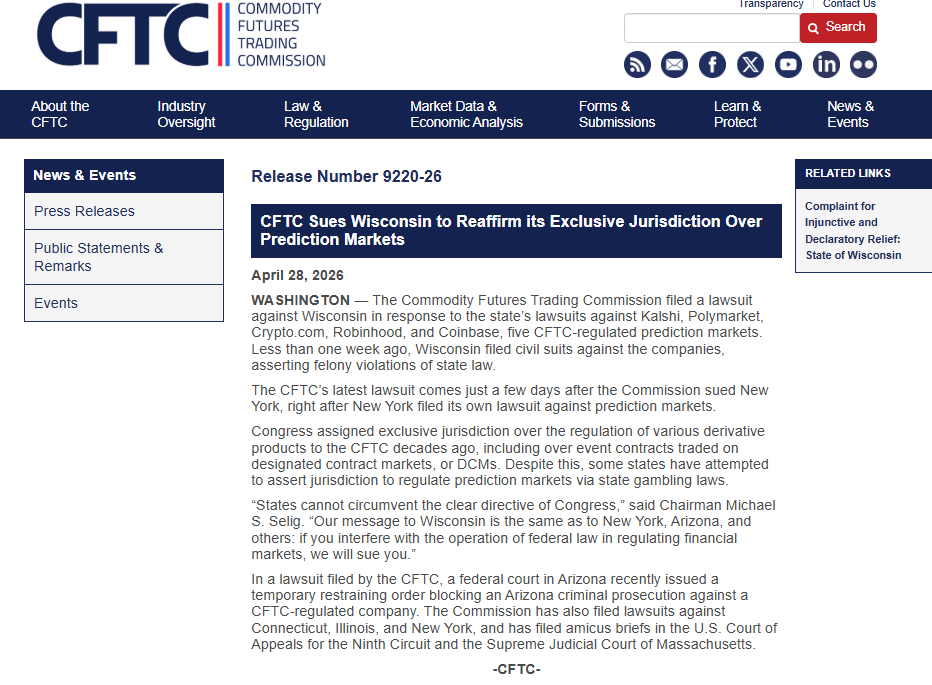
The lawsuit targets Governor Tony Evers, Attorney General Joshua Kaul, and gaming administrator John Dillett. The case was filed in the U.S. District Court for the Eastern District of Wisconsin.
In its complaint, the CFTC argued that it holds “exclusive jurisdiction” over prediction markets, stating that Wisconsin’s actions interfere with federal authority governing national swaps markets.
Conflict Triggered by State Action Against Platforms
The federal lawsuit followed Wisconsin’s legal actions last week against several prediction market and trading platforms, including Coinbase, Robinhood, Crypto.com, Polymarket, and Kalshi.
Wisconsin officials labeled certain sports-related event contracts offered by these platforms as a “public nuisance.” In response, the CFTC argued that attempts to criminalize federally regulated markets undermine the unified federal regulatory framework designed by Congress.
This marks the fifth state lawsuit filed by the CFTC in the past month, following similar actions against Illinois, Arizona, Connecticut, and New York.
States Push Back on Federal Authority
State officials across the country continue to challenge federal claims of authority. A bipartisan coalition of 37 state attorneys general, including those from New York and Oklahoma, recently filed an amicus brief in a Massachusetts court supporting a January ruling against Kalshi.
That ruling determined that Kalshi cannot offer sports event contracts to Massachusetts residents without approval from the state’s gaming regulators. The coalition argued that if Congress intended to override state gambling laws, it would have done so explicitly.
Broader Regulatory Battle Intensifies
The dispute reflects a larger regulatory battle over the classification of prediction markets—whether they fall under financial derivatives law or state-level gambling regulations. Michael Selig has maintained that the agency’s authority is broad enough to regulate these markets nationwide, despite opposition from states citing traditional control over gambling.
The CFTC is now seeking an injunction that would prevent Wisconsin officials from enforcing state gambling laws against federally regulated event contract markets. The outcome of this legal fight could shape the future structure of prediction markets and determine whether federal or state authorities ultimately control the rapidly growing sector.
Live market reaction
Disclaimer
This content is for informational purposes only and does not constitute financial, investment, or legal advice. Cryptocurrency trading involves risk and may result in financial loss.
Start trading
with BloFin today
Up to $500 sign-up bonus and zero-fee trading on your first 30 days.
Buy crypto nowⓘ You will be redirected to BloFin
About the author
8+ years covering crypto markets, macro, and geopolitics. Previously at Decrypt and CoinDesk. Focused on the intersection of digital assets and traditional finance.

.jpeg&w=32&q=75) Laurisa ·
Laurisa · 
 Tristan R. ·