


Photo: Illustrative
Circle Faces Lawsuit After $280 Million Drift Protocol Hack Over Unfrozen USDC Funds
Stablecoin issuer Circle Internet Group is facing a class action lawsuit after the $280 million exploit of Drift Protocol on April 1, with investors alleging the company failed to act quickly to stop stolen funds from being moved. The lawsuit was filed in a U.S. district court in Massachusetts by Drift investor Joshua McCollum on behalf of more than 100 affected investors.
.jpeg)
Investor Joshua McCollum Files Class Action Alleging Negligence by Circle
Stablecoin issuer Circle Internet Group is facing a class action lawsuit after the $280 million exploit of Drift Protocol on April 1, with investors alleging the company failed to act quickly to stop stolen funds from being moved. The lawsuit was filed in a U.S. district court in Massachusetts by Drift investor Joshua McCollum on behalf of more than 100 affected investors.
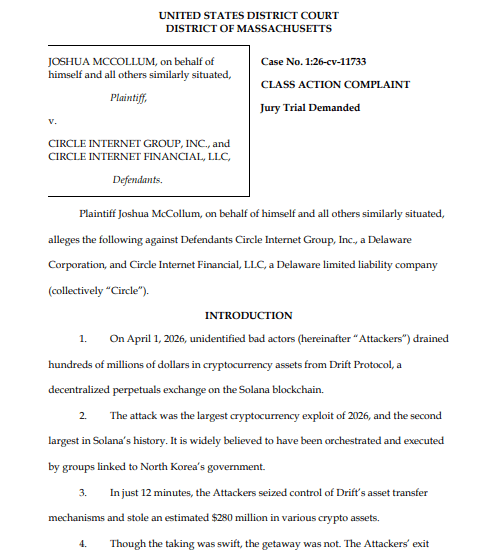
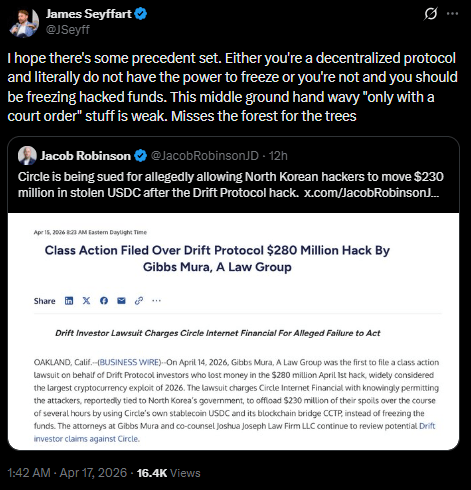
The complaint claims Circle allowed attackers to transfer approximately $230 million in USDC from the Solana blockchain to Ethereum using Circle’s Cross-Chain Transfer Protocol (CCTP) over several hours without intervention. Attorneys representing McCollum argued that Circle permitted the criminal use of its services and that the losses could have been prevented or reduced if timely action had been taken. The lawsuit accuses Circle of aiding and abetting conversion and negligence, with damages to be determined during trial proceedings.
Legal Debate Grows Over Crypto Firms’ Responsibility During Hacks
The case highlights a growing legal grey area regarding whether crypto companies should intervene when exploits occur. Lawyers representing the investors noted that Circle froze 16 USDC wallets in connection with a sealed civil case roughly a week before the Drift incident, suggesting the company had the technical capability to act.
Blockchain analytics firm Elliptic linked the exploit to suspected North Korean state-backed hackers, who reportedly executed more than 100 transactions during U.S. working hours. The stolen funds were later converted into Ether and routed through the Tornado Cash privacy protocol to obscure their origin.
Lorenzo Valente, director of research for digital assets at ARK Invest, argued that freezing funds without a legal order could create risks of arbitrary decision-making, underscoring the broader debate between regulatory compliance and rapid intervention during cyberattacks.
Disclaimer
This content is for informational purposes only and does not constitute financial, investment, or legal advice. Cryptocurrency trading involves risk and may result in financial loss.
Live market reaction
Disclaimer
This content is for informational purposes only and does not constitute financial, investment, or legal advice. Cryptocurrency trading involves risk and may result in financial loss.
Start trading
with BloFin today
Up to $500 sign-up bonus and zero-fee trading on your first 30 days.
Buy crypto nowⓘ You will be redirected to BloFin
About the author
Emerging voice in crypto journalism with a background in fintech and digital economics. Covers DeFi, NFTs, and the evolving regulatory landscape.

 Tristan R. ·
.jpeg&w=32&q=75) Laurisa ·
Laurisa ·