




Photo: Illustrative
Gold Records Sharpest Weekly Drop Since 1983 Amid Iran War and Rate Concerns
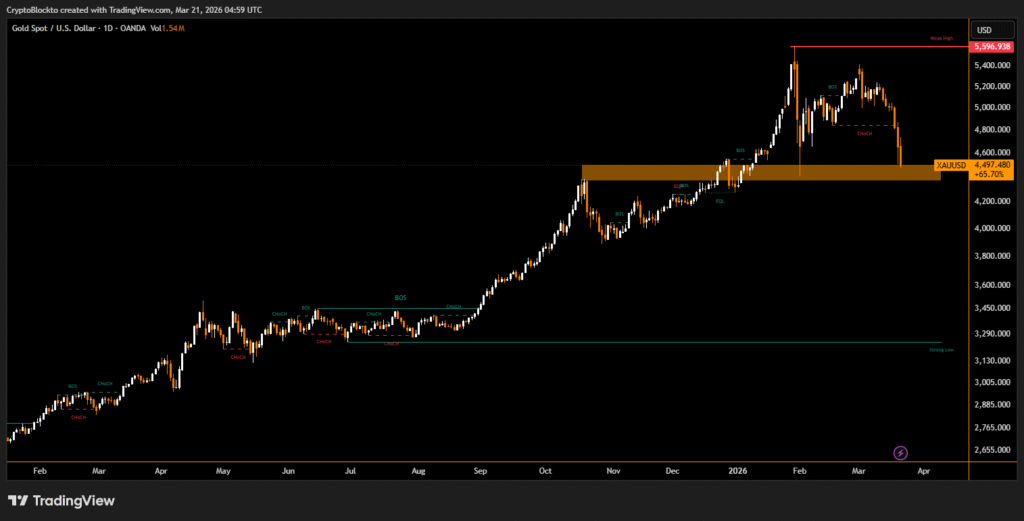
Gold prices suffered a steep decline this week, falling 3.5% to $4,488 per ounce on Friday and recording an 11% weekly loss the largest weekly drop for the precious metal since 1983. The sharp fall comes as geopolitical instability linked to the ongoing US and Israel–Iran conflict continues to influence global markets and investor positioning.

Gold prices suffered a steep decline this week, falling 3.5% to $4,488 per ounce on Friday and recording an 11% weekly loss the largest weekly drop for the precious metal since 1983. The sharp fall comes as geopolitical instability linked to the ongoing US and Israel–Iran conflict continues to influence global markets and investor positioning.
War-Driven Volatility and Oil Disruptions Pressure Gold Prices
Gold has dropped more than 15% since Feb. 28, when military strikes on Iran began, reversing part of the strong rally that pushed prices to nearly $5,500 in late January. Market data confirmed that the March 16–20 period marked the weakest weekly performance for gold in more than four decades.
Tensions in the Middle East have disrupted global oil flows, particularly around the Strait of Hormuz, raising fears of a prolonged energy crisis. While US officials signaled possible plans to reduce military activity, additional troops were deployed as air operations continued, maintaining uncertainty across financial markets.
Interest Rate Expectations and Inflation Outlook Weigh on Safe-Haven Demand
Investor sentiment has also been shaped by expectations that the US Federal Reserve will keep interest rates unchanged this year. Stable or higher rates typically increase the appeal of bonds and other yield-bearing assets, reducing demand for non-yielding assets like gold.
Federal Reserve Chair Jerome Powell indicated that rising energy costs are likely to push inflation higher in the near term, reinforcing expectations that monetary easing may be delayed.
Bitcoin Performance Narrows Gap With Gold
Despite gold’s longer-term strength, Bitcoin has shown relative resilience during the conflict period. Over the past 12 months, gold gained about 48.5%, while Bitcoin declined roughly 16.5%. However, since the first attacks on Iran, Bitcoin has risen more than 11.6% to around $70,535, recovering ground against gold during the recent market turmoil.
Disclaimer
This content is for informational purposes only and does not constitute financial, investment, or legal advice. Cryptocurrency trading involves risk and may result in financial loss.
Live market reaction
Disclaimer
This content is for informational purposes only and does not constitute financial, investment, or legal advice. Cryptocurrency trading involves risk and may result in financial loss.
Start trading
with BloFin today
Up to $500 sign-up bonus and zero-fee trading on your first 30 days.
Buy crypto nowⓘ You will be redirected to BloFin
About the author
8+ years covering crypto markets, macro, and geopolitics. Previously at Decrypt and CoinDesk. Focused on the intersection of digital assets and traditional finance.

BitMine Expands Ethereum Holdings With $238M Purchase, Nears 5% Supply Target
.jpeg&w=32&q=75) Laurisa ·
Laurisa · 
Bitcoin Price Outlook: Why BTC Could Move Toward $95K After $80K Recovery
 Tristan R. ·
Trump-Linked World Liberty Files Defamation Case Against Justin Sun Over WLFI Token Dispute
Laurisa ·