


Photo: Illustrative
Iran Demands Crypto or Yuan Payments for Ships Crossing Strait of Hormuz
Iran has introduced a new transit payment system requiring ships to pay in cryptocurrencies or Chinese yuan to cross the Strait of Hormuz, transforming the strategic waterway into a tightly controlled passage managed by the Islamic Revolutionary Guard Corps (IRGC). Under the new process, vessels seeking entry must submit detailed operational data, including ownership, cargo details, flag, crew information, destination, and real-time tracking data before receiving approval.

Iran has introduced a new transit payment system requiring ships to pay in cryptocurrencies or Chinese yuan to cross the Strait of Hormuz, transforming the strategic waterway into a tightly controlled passage managed by the Islamic Revolutionary Guard Corps (IRGC). Under the new process, vessels seeking entry must submit detailed operational data, including ownership, cargo details, flag, crew information, destination, and real-time tracking data before receiving approval.
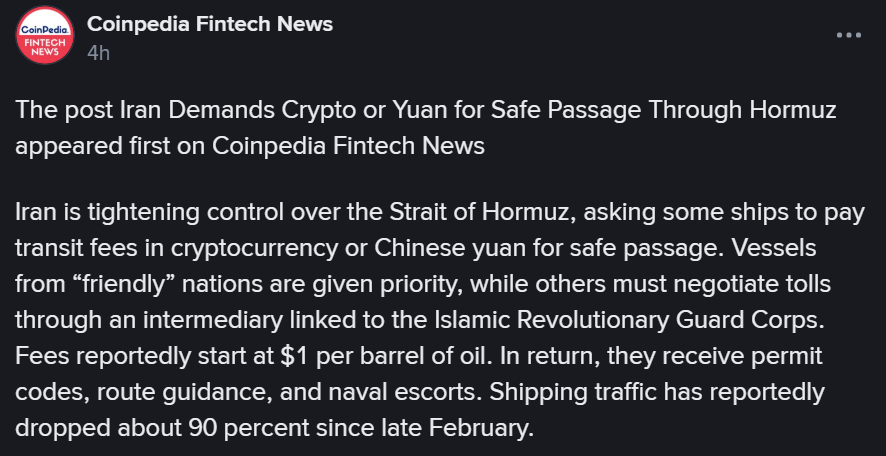
The policy applies primarily to vessels from nations considered “friendly,” while ships heading to the United States or Israel are reportedly restricted from passage. Approved vessels receive clearance codes and are guided through designated IRGC-monitored corridors, sometimes accompanied by armed escorts to ensure safe transit.
Impact on Global Oil Trade and Dollar-Dominated Settlements
The Strait of Hormuz carries an estimated 20% to 25% of global oil supply, making the new toll structure highly significant for international energy markets. Payments reportedly start at about $1 per barrel of oil, meaning total transit costs for large shipments can reach millions of dollars depending on cargo volume and risk levels.
With roughly 80% to 85% of global oil trades traditionally settled in US dollars, the introduction of yuan and crypto payment options signals a potential shift in settlement practices. Countries heavily dependent on the strait, including Japan and Singapore, rely on it for a majority of their oil imports, leaving them limited alternatives.
Strait of Hormuz Management Plan and Shipping Disruptions
The payment framework forms part of Iran’s Strait of Hormuz Management Plan, which establishes security procedures, environmental controls, coordination measures with Oman, and structured toll rules. The plan also restricts access for certain allied nations and introduces stricter operational oversight.
Shipping activity through the strait has reportedly declined sharply following the rollout of the system, highlighting the growing geopolitical and economic pressure surrounding one of the world’s most critical energy corridors.
Disclaimer
This content is for informational purposes only and does not constitute financial, investment, or legal advice. Cryptocurrency trading involves risk and may result in financial loss.
Live market reaction
Disclaimer
This content is for informational purposes only and does not constitute financial, investment, or legal advice. Cryptocurrency trading involves risk and may result in financial loss.
Start trading
with BloFin today
Up to $500 sign-up bonus and zero-fee trading on your first 30 days.
Buy crypto nowⓘ You will be redirected to BloFin
About the author
8+ years covering crypto markets, macro, and geopolitics. Previously at Decrypt and CoinDesk. Focused on the intersection of digital assets and traditional finance.

 Tristan R. ·
.jpeg&w=32&q=75) Laurisa ·
Laurisa ·