




Photo: Illustrative
Quantum Computing Threat to Bitcoin: Should Vulnerable Coins Be Frozen or Burned?
Advances in quantum computing are reviving a long-running debate inside the Bitcoin community: what should happen if powerful machines can one day break the network’s cryptography?

Advances in quantum computing are reviving a long-running debate inside the Bitcoin community: what should happen if powerful machines can one day break the network’s cryptography?
Estimates suggest nearly 7 million BTC could be exposed in a sufficiently advanced quantum scenario. That figure includes roughly 1 million coins widely attributed to Satoshi Nakamoto. At current prices near $67,600, the potentially vulnerable holdings represent about $440 billion in value.
Why Early Bitcoin Addresses Could Be at Risk
In Bitcoin’s early years, some transactions used pay to public key (P2PK) formats that revealed public keys directly on-chain. Modern address standards typically conceal public keys behind hashed formats until coins are spent. However, once a public key has been exposed through early mining rewards or address reuse that exposure is permanent.
Ki Young Ju, the founder of CryptoQuant recently wrote on X;

If quantum systems eventually defeat elliptic curve cryptography, exposed keys could theoretically be reversed, enabling unauthorized transfers.
Neutrality Versus Protocol Intervention
One camp argues that freezing or burning at-risk coins would violate Bitcoin’s neutrality and immutability. Because the protocol treats all unspent outputs equally, distinguishing between “lost” and “dormant” coins is technically impossible.
Others contend that allowing quantum attackers to sweep vulnerable funds would unfairly reward whoever controls advanced hardware. Proposed solutions include a soft fork that renders exposed outputs unspendable unless migrated to quantum resistant addresses before a set deadline.
How Immediate Is the Quantum Threat?
While some researchers believe breakthroughs could accelerate timelines for breaking encryption, others maintain that large scale, fault-tolerant quantum machines remain years away. Many developers view the issue as an engineering challenge that can be addressed through cryptographic upgrades rather than emergency governance changes.
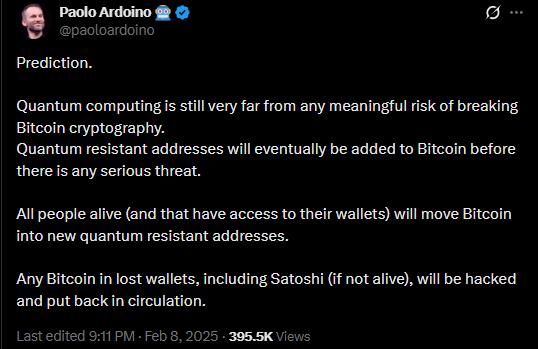
Paolo Ardoino, CEO of Tether, suggested that;
Ultimately, the debate centers on timing, consensus and whether protecting the network justifies altering its foundational rules.
Disclaimer
This content is for informational purposes only and does not constitute financial, investment, or legal advice. Cryptocurrency trading involves risk and may result in financial loss.
Live market reaction
Disclaimer
This content is for informational purposes only and does not constitute financial, investment, or legal advice. Cryptocurrency trading involves risk and may result in financial loss.
Start trading
with BloFin today
Up to $500 sign-up bonus and zero-fee trading on your first 30 days.
Buy crypto nowⓘ You will be redirected to BloFin
About the author
8+ years covering crypto markets, macro, and geopolitics. Previously at Decrypt and CoinDesk. Focused on the intersection of digital assets and traditional finance.

BitMine Expands Ethereum Holdings With $238M Purchase, Nears 5% Supply Target
.jpeg&w=32&q=75) Laurisa ·
Laurisa · 
Bitcoin Price Outlook: Why BTC Could Move Toward $95K After $80K Recovery
 Tristan R. ·
Trump-Linked World Liberty Files Defamation Case Against Justin Sun Over WLFI Token Dispute
Laurisa ·