


Photo: Illustrative
South Africa Draft Bill Proposes Stricter Crypto Capital Controls and Declaration Rules
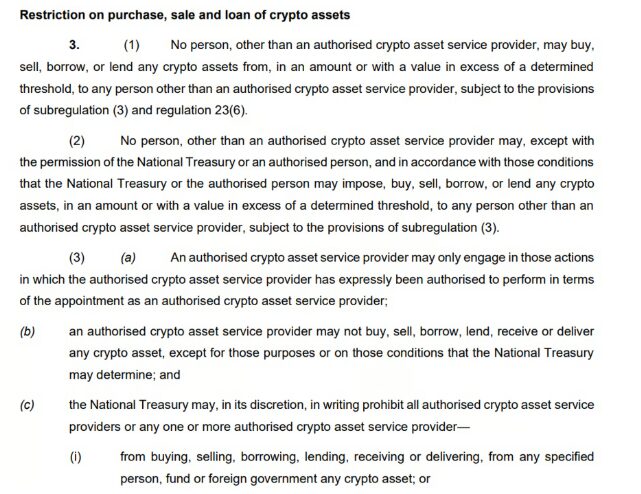
South Africa’s National Treasury has released draft Capital Flow Management Regulations that would bring crypto transactions under the country’s exchange control system. Published on April 17, the proposal would require crypto holders above a yet-to-be-defined threshold to declare their digital asset investments within 30 days. In certain cases, crypto purchased through authorized providers for a specific purpose would have to be sold if no longer needed for that purpose.

South Africa’s National Treasury has released draft Capital Flow Management Regulations that would bring crypto transactions under the country’s exchange control system. Published on April 17, the proposal would require crypto holders above a yet-to-be-defined threshold to declare their digital asset investments within 30 days. In certain cases, crypto purchased through authorized providers for a specific purpose would have to be sold if no longer needed for that purpose.
The draft remains open for public comment until May 18 and is designed to replace the long-standing Exchange Control Regulations of 1961, marking one of the most significant overhauls of the country’s capital control framework in decades.
Transaction Limits and Cross-Border Controls Proposed
Under the proposal, some cryptocurrency transactions above the set threshold would be limited to authorized crypto asset service providers or require prior approval from the National Treasury. The rules would also criminalize unauthorized cross-border bitcoin transfers and require travelers to declare cryptocurrency holdings when leaving the country.
Authorities would grant enforcement officers the power to inspect personal belongings to verify possession of currency or crypto assets. Violations could lead to fines of up to 1,000,000 South African rand, roughly $60,000, and prison sentences of up to five years.
Industry Voices Raise Concerns Over Scope and Timing
Cryptocurrency activity in South Africa is currently governed under the Financial Advisory and Intermediary Services Act after the Financial Sector Conduct Authority classified crypto as a financial product in 2022. However, critics say the new rules may be overly restrictive.
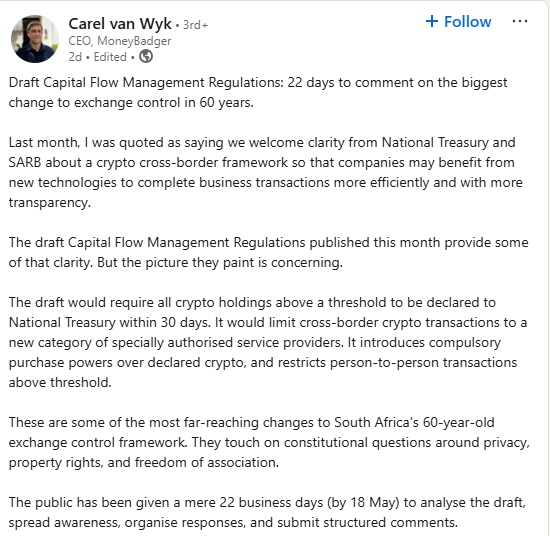
Carel van Wyk, founder of crypto payments firm MoneyBadger, warned that the short public feedback window is insufficient for reforms of this scale. He also noted that the proposal introduces compulsory purchase powers over declared crypto and restricts peer-to-peer transactions above certain limits while confining cross-border transfers to specially authorized service providers.
Disclaimer
This content is for informational purposes only and does not constitute financial, investment, or legal advice. Cryptocurrency trading involves risk and may result in financial loss.
Live market reaction
Disclaimer
This content is for informational purposes only and does not constitute financial, investment, or legal advice. Cryptocurrency trading involves risk and may result in financial loss.
Start trading
with BloFin today
Up to $500 sign-up bonus and zero-fee trading on your first 30 days.
Buy crypto nowⓘ You will be redirected to BloFin
About the author
8+ years covering crypto markets, macro, and geopolitics. Previously at Decrypt and CoinDesk. Focused on the intersection of digital assets and traditional finance.

 Tristan R. ·
.jpeg&w=32&q=75) Laurisa ·
Laurisa ·