


Photo: Illustrative
Web3 Hacks Cost $464 Million in Q1 2026 as Phishing Attacks Dominate Crypto Security Losses
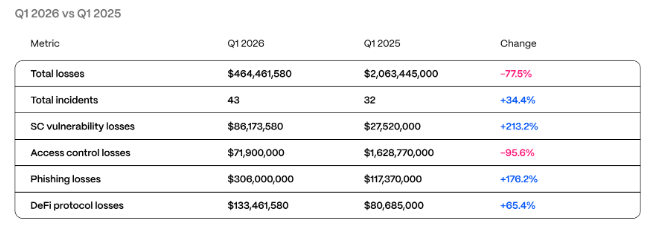
Web3 platforms recorded losses of approximately $464.5 million across 43 security incidents during the first quarter of 2026, according to a new report by Hacken. The findings show that phishing and social engineering attacks were the leading causes of financial damage, accounting for $306 million in total losses. A single hardware wallet phishing incident in January alone resulted in a $282 million loss, representing roughly 81% of the quarter’s total damage.
.jpeg)
Web3 platforms recorded losses of approximately $464.5 million across 43 security incidents during the first quarter of 2026, according to a new report by Hacken. The findings show that phishing and social engineering attacks were the leading causes of financial damage, accounting for $306 million in total losses. A single hardware wallet phishing incident in January alone resulted in a $282 million loss, representing roughly 81% of the quarter’s total damage.
Smart contract vulnerabilities also remained a key threat, contributing $86.2 million in losses, while compromised keys and access control failures added another $71.9 million. Despite these figures, the quarter ranked as the second-lowest first-quarter loss level since 2023, largely due to the absence of mega-scale incidents like the $1.46 billion hack involving Bybit in early 2025.
Legacy Code and Infrastructure Weaknesses Increase Attack Risks
Security experts noted that many of the most costly failures occurred outside core blockchain code, particularly within infrastructure and operational layers. Notable incidents included a $40 million attack involving fake venture capital outreach targeting Step Finance and a $25 million compromise involving cloud-based key management at Resolv Labs. Older smart contract deployments also remained vulnerable, including a $26.4 million exploit affecting Truebit and a donation attack impacting Venus Protocol.
Regulators Tighten Compliance and Incident Response Standards
Growing losses and operational risks have prompted regulators to strengthen enforcement requirements worldwide. Frameworks such as the Markets in Crypto-Assets Regulation and the Digital Operational Resilience Act are introducing stricter monitoring, reporting, and response standards.
Additional regulatory measures have also been implemented in regions such as Dubai, Singapore, and the United Arab Emirates, reflecting a global shift toward faster incident detection timelines. Recommended targets now include detecting threats within 24 hours, labeling suspicious activity within four hours, and blocking attacks within seconds, signaling a new era of continuous security oversight in the Web3 sector.
Disclaimer
This content is for informational purposes only and does not constitute financial, investment, or legal advice. Cryptocurrency trading involves risk and may result in financial loss.
Live market reaction
Disclaimer
This content is for informational purposes only and does not constitute financial, investment, or legal advice. Cryptocurrency trading involves risk and may result in financial loss.
Start trading
with BloFin today
Up to $500 sign-up bonus and zero-fee trading on your first 30 days.
Buy crypto nowⓘ You will be redirected to BloFin
About the author
Emerging voice in crypto journalism with a background in fintech and digital economics. Covers DeFi, NFTs, and the evolving regulatory landscape.

 Tristan R. ·
.jpeg&w=32&q=75) Laurisa ·
Laurisa ·