


Photo: Illustrative
Wisconsin Sues Kalshi, Coinbase, Polymarket, Robinhood and Crypto.com Over Prediction Market Gambling Claims
Wisconsin has filed lawsuits against Kalshi, Coinbase, Polymarket, Robinhood, and Crypto.com, alleging that their prediction market products operate as illegal gambling under state law rather than regulated financial instruments. The complaint argues that “event contracts” are effectively wagers on real world outcomes, not investment products.

Wisconsin has filed lawsuits against Kalshi, Coinbase, Polymarket, Robinhood, and Crypto.com, alleging that their prediction market products operate as illegal gambling under state law rather than regulated financial instruments. The complaint argues that “event contracts” are effectively wagers on real world outcomes, not investment products.
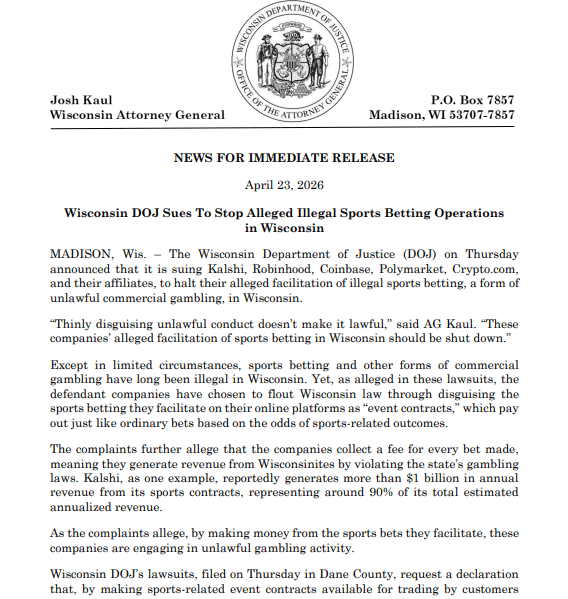
According to Attorney General Josh Kaul, “thinly disguising unlawful conduct doesn’t make it lawful,” reinforcing the state’s position that prediction markets fall under gambling statutes rather than commodity trading rules.
Core Legal Dispute: Gambling vs Federal Financial Regulation
At the center of the case is whether prediction market contracts fall under the jurisdiction of the US Commodity Futures Trading Commission (CFTC) or state gambling regulators. This distinction determines whether platforms operate under a unified federal framework or face regulation across all 50 states.
Wisconsin’s filings argue that users pay to take positions on outcomes such as sports events, with fixed payouts of $1 for correct predictions and zero for losses, mirroring traditional betting structures.
The state also highlights platform marketing, citing Kalshi’s description of itself as a “nationwide legal sports betting platform” and Polymarket’s framing of its service as betting on future events.
Revenue Model and Industry Defense
The lawsuits also note that platforms generate income through transaction fees on each contract, which Wisconsin compares to casinos collecting fees on wagers.
In defense, platforms argue that prediction markets are federally regulated financial instruments under CFTC oversight. Kalshi has previously claimed its contracts are legally listed swaps.
This case adds to a growing multi-state conflict, with Nevada and New York already classifying similar contracts as gambling. The dispute increases pressure on federal courts and may ultimately reach the US Supreme Court to determine whether prediction markets are financial products or regulated betting systems.
Disclaimer
This content is for informational purposes only and does not constitute financial, investment, or legal advice. Cryptocurrency trading involves risk and may result in financial loss.
Live market reaction
Disclaimer
This content is for informational purposes only and does not constitute financial, investment, or legal advice. Cryptocurrency trading involves risk and may result in financial loss.
Start trading
with BloFin today
Up to $500 sign-up bonus and zero-fee trading on your first 30 days.
Buy crypto nowⓘ You will be redirected to BloFin
About the author
8+ years covering crypto markets, macro, and geopolitics. Previously at Decrypt and CoinDesk. Focused on the intersection of digital assets and traditional finance.

 Tristan R. ·
.jpeg&w=32&q=75) Laurisa ·
Laurisa ·