

The State Bank of Pakistan has allowed banks to open accounts for licensed virtual asset service providers (VASPs), ending an eight-year prohibition on dealing with virtual currencies.
According to a circular issued on April 14, regulated banks can now provide banking services to firms licensed by the Pakistan Virtual Assets Regulatory Authority. The move follows the approval of the Virtual Assets Act 2026 in March, marking a major step toward a formal regulatory framework for digital assets after restrictions first imposed in 2018.
Banking Access Granted Under Strict Compliance Requirements
Under the new framework, banks are not permitted to trade, invest, or hold crypto assets using their own funds or customer deposits. Their role is limited strictly to providing banking services for licensed crypto entities.
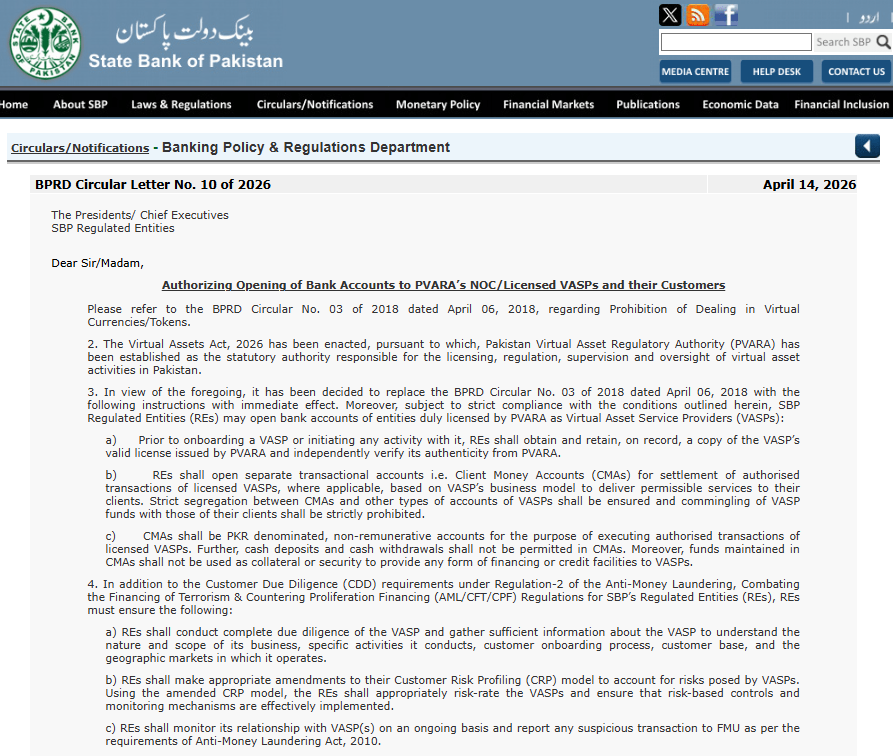
Banks must open separate transactional accounts in Pakistani rupees, known as Client Money Accounts (CMAs), ensuring strict segregation between customer funds and operational accounts. Financial institutions are also required to comply fully with foreign exchange regulations, anti-money laundering (AML), and counter-terrorism financing (CFT) rules.
Ongoing monitoring of crypto-related transactions is mandatory, and suspicious activities must be reported to Pakistan’s Financial Monitoring Unit.
Policy Shift Reflects Broader Effort to Build Regulated Crypto Ecosystem
The policy change follows increased engagement between Pakistani authorities and major global exchanges, including Binance and HTX, during discussions held in late 2025.
Pakistan has also explored blockchain-based financial systems through talks with affiliates of World Liberty Financial, including potential use of stablecoins for cross-border payments.
The decision signals a shift from restrictive policies toward regulated adoption, potentially opening the door for licensed crypto platforms to operate more effectively within Pakistan’s financial system.
Disclaimer
This content is for informational purposes only and does not constitute financial, investment, or legal advice. Cryptocurrency trading involves risk and may result in financial loss.