
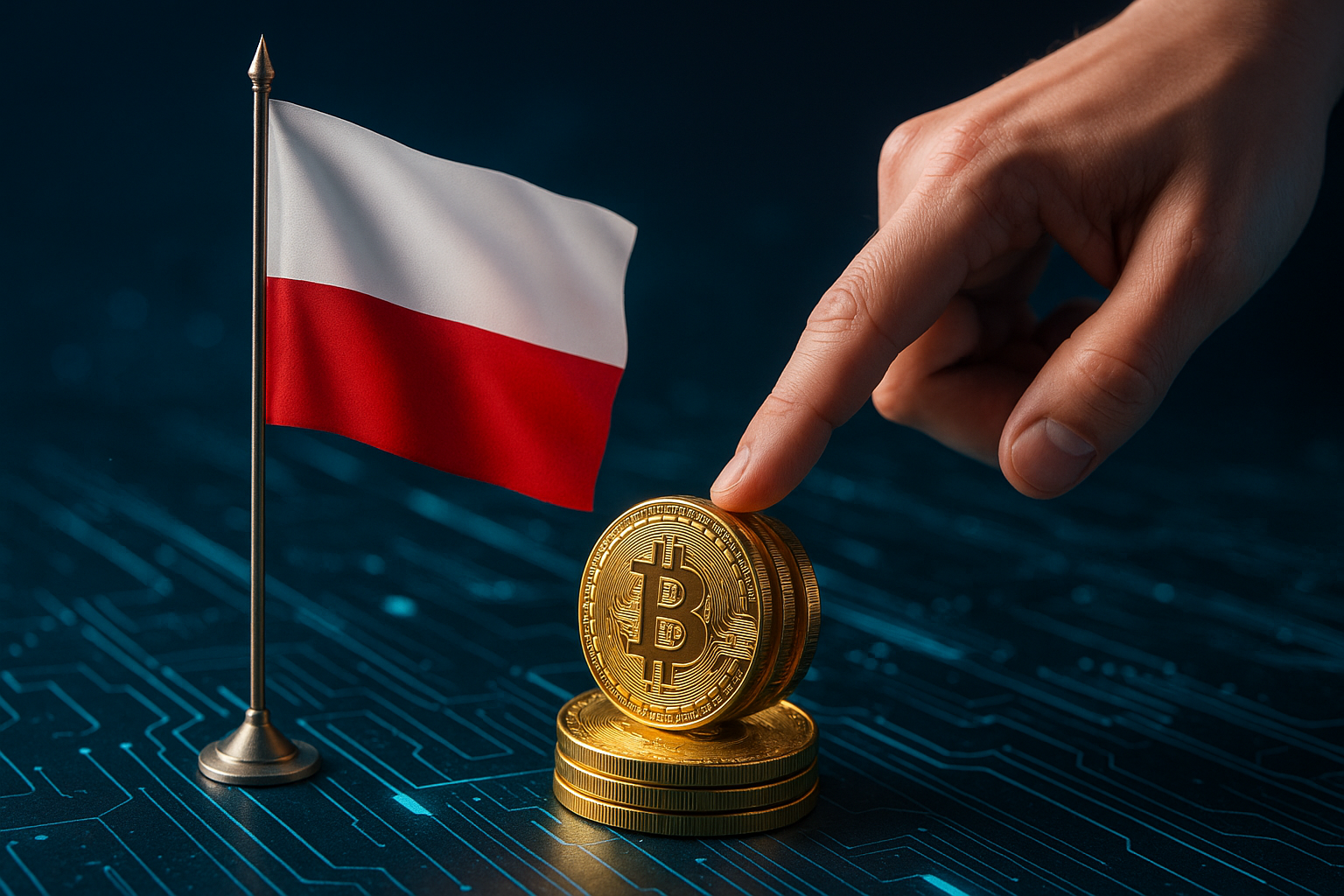
New Crypto-Asset Market Act Could Reshape Poland’s Digital Asset Industry

Poland has taken a major step toward regulating its digital asset industry after the Sejm (lower house of parliament) approved the Crypto-Asset Market Act (Bill 1424) on Friday. The bill now moves to the Senate for review, but it has already triggered significant backlash from crypto holders, lawmakers, and industry advocates.

Licensing, Heavy Fines, and Prison Terms

The legislation introduces a mandatory licensing framework for crypto asset service providers (CASPs), including exchanges, issuers, and custody platforms. Oversight will fall under the Polish Financial Supervision Authority (KNF).

To obtain a license, CASPs must prove compliance with capital adequacy standards, internal controls, risk management systems, and Anti-Money Laundering (AML) rules.

Violations carry heavy consequences:

  • Fines up to 10 million PLN ($2.8 million)
  • Prison sentences of up to two years
  • Possible shutdowns for unlicensed firms

If enacted, CASPs will have a six-month transitional period to secure their licenses.

Critics Warn of Market “Destruction”

The bill passed with 230 votes in favor and 196 against, reflecting deep political division.

Opposition lawmaker Janusz Kowalski blasted the legislation as “the largest and most restrictive cryptocurrency law in the EU”, warning it could devastate Poland’s market of over three million crypto holders. He criticized the text’s 118 pages of regulations, contrasting it with shorter, less restrictive laws in Germany and the Czech Republic.

Meanwhile, blockchain advocate Tomasz Mentzen highlighted Poland’s slow bureaucracy, noting that the KNF takes an average of 30 months to process applications — a delay that could choke innovation. He argued the bill signals the “destruction of blockchain and stablecoins” in Poland unless vetoed by the Senate or President.

Political Promises vs. Regulatory Reality

Polish President Karol Nawrocki, elected in June 2025, had pledged to support crypto and resist “tyrannical regulations” before taking office. His position on the new bill will be closely watched, as veto power remains a key check on its enforcement.

His campaign rival, Sławomir Mentzen, had gone even further, promising to build a national Bitcoin (BTC) reserve if elected. Although Nawrocki won the runoff with 50.9% of the vote, many in Poland’s crypto community are now pressuring him to honor his campaign pledge to protect digital innovation.

The legislation is designed to align Poland with the EU’s Markets in Crypto-Assets Regulation (MiCA), but critics argue the country’s approach is unnecessarily harsh. With Poland hosting one of Europe’s fastest-growing crypto communities, the bill’s outcome could set a precedent for how MiCA is enforced across the EU.

Disclaimer

This content is for informational purposes only and does not constitute financial, investment, or legal advice. Cryptocurrency trading involves risk and may result in financial loss.

logo

blockto.io

info@blockto.io

Blockto.io Copyright © 2025, All rights reserved

News
Rates
Buy
More
We use cookies to personalize content and ads, provide social media features, and analyze our traffic. In accordance with GDPR/AVG and EU cookie regulations, data is processed only with your consent. We may share information about your use of our website with our social media, advertising, and analytics partners, and you can manage or withdraw your consent at any time. View more
Cookies settings
Accept
Privacy & Cookie policy
Privacy & Cookies policy
Cookie name Active

Privacy Policy

At BitxJournal.com, we respect your privacy and are committed to protecting your personal data. This Privacy Policy explains how we collect, process, store, and protect personal information in accordance with the General Data Protection Regulation (GDPR) and AVG (EU privacy legislation).

1. Data Controller

BitxJournal.com acts as the data controller for all personal data processed through this website.

2. Personal Data We Collect

We may collect and process the following categories of data:

Personal Data

  • Name and email address (when you subscribe to newsletters or contact us)

Technical & Usage Data

  • IP address, browser type, operating system

  • Device information

  • Pages visited, referral sources, and interaction data

This data is collected via cookies, log files, and analytics technologies.

3. Legal Basis for Processing

We process personal data only when a lawful basis exists, including:

  • Consent – when you explicitly agree (e.g., cookies, newsletter sign-up)

  • Legitimate interest – to operate, secure, and improve our website

  • Legal obligation – when required by applicable laws

You may withdraw your consent at any time.

4. Purpose of Data Processing

Your data is processed for the following purposes:

  • Operating and maintaining the website

  • Improving content, usability, and performance

  • Sending newsletters or updates (only with consent)

  • Analyzing traffic and user behavior

  • Responding to inquiries or support requests

5. Cookies & Consent Management

We use cookies and similar technologies in compliance with EU Cookie Law.

  • Non-essential cookies are placed only after explicit user consent

  • Users may accept, reject, or manage cookie preferences at any time

  • Consent can be withdrawn without affecting prior lawful processing

Detailed cookie information is available in our Cookie Settings panel.

6. Third-Party Data Processing

We may share limited data with trusted third-party service providers, including:

  • Analytics providers (e.g., Google Analytics)

  • Advertising partners (for personalized or non-personalized ads)

These third parties act as data processors and process data only under contractual obligations compliant with GDPR/AVG.

7. International Data Transfers

Where data is transferred outside the European Economic Area (EEA), we ensure appropriate safeguards are in place, such as Standard Contractual Clauses (SCCs) or equivalent legal mechanisms.

8. Data Retention

We retain personal data only for as long as necessary to fulfill the purposes outlined in this policy or as required by law.

9. Data Security

We implement appropriate technical and organizational security measures to protect personal data against unauthorized access, alteration, disclosure, or destruction.

10. Your GDPR Rights

Under GDPR/AVG, you have the right to:

  • Access your personal data

  • Rectify inaccurate or incomplete data

  • Request data erasure (“right to be forgotten”)

  • Restrict or object to processing

  • Data portability

  • Withdraw consent at any time

  • Lodge a complaint with a supervisory authority

11. Changes to This Privacy Policy

We reserve the right to update this Privacy Policy at any time. Any changes will be posted on this page with a revised effective date.

12. Contact Information

For privacy-related inquiries or GDPR requests, contact:

📧 Email: support@blockto.io
🌐 Website: https://blockto.io

Save settings
Cookies settings