

Bitcoin Security Relies on Elliptic Curve Cryptography

The security of Bitcoin depends on a cryptographic method known as Elliptic Curve Cryptography. Each Bitcoin wallet uses a private key a secret 256-bit number to generate a public key using a mathematical curve called secp256k1.

This system functions as a one-way mathematical process. While generating a public key from a private key is fast, reversing the process using classical computers is considered practically impossible. The difficulty of solving the elliptic curve discrete logarithm problem means that traditional machines would require more time than the age of the universe to determine a private key from a public key.

Shor’s Algorithm Presents a Breakthrough Risk

In 1994, mathematician Peter Shor introduced Shor’s Algorithm, a method capable of solving the discrete logarithm problem efficiently using quantum computing. Unlike classical systems, quantum computers use superposition, entanglement and interference to analyze many possible values simultaneously.
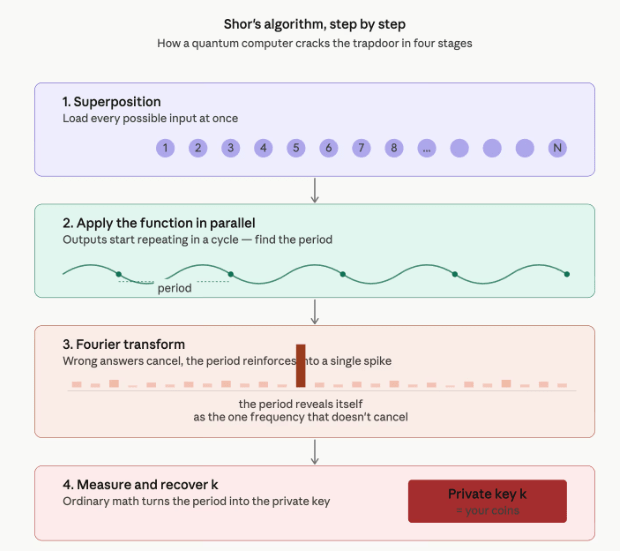
By identifying repeating mathematical patterns within elliptic curve operations, Shor’s Algorithm can determine the private key associated with a public key. Once recovered, the attacker could control the corresponding wallet and transfer funds without authorization.

Google Research Suggests a Nine-Minute Attack Window

A recent study from Google’s Quantum AI division, with contributions from researchers including Justin Drake and Dan Boneh, proposed a realistic attack model targeting Bitcoin encryption.

The research reduced previous hardware estimates from millions of qubits to fewer than 500,000 physical qubits, using around 1,200 to 1,450 logical qubits and tens of millions of Toffoli gates. The study also showed that much of the required computation could be completed in advance, allowing the final stage to finish in about nine minutes once a public key becomes visible.

Exposure Risk and Long-Term Implications

Bitcoin transactions typically confirm in roughly 10 minutes, creating a narrow window where attackers could attempt to intercept funds during broadcast. Researchers estimate attackers could have about a 41% chance of completing the calculation before confirmation.

A larger concern involves approximately 6.9 million bitcoin, nearly one-third of total supply, stored in wallets where public keys are already visible. These holdings could be targeted without time pressure if sufficiently advanced quantum hardware becomes available.

While such machines do not yet exist, the research highlights the growing importance of quantum-resistant cryptographic upgrades to secure long-term blockchain infrastructure.

Disclaimer

This content is for informational purposes only and does not constitute financial, investment, or legal advice. Cryptocurrency trading involves risk and may result in financial loss.

Buy Crypto
You will be redirected to BloFin
logo_blockto.io

Blockto.io

info@blockto.io

Address: Overvliet 21, 3545NG, Utrecht

Blockto.io Copyright © 2026, All rights reserved

News
Rates
Buy
Events
We use cookies to personalize content and ads, provide social media features, and analyze our traffic. In accordance with GDPR/AVG and EU cookie regulations, data is processed only with your consent. We may share information about your use of our website with our social media, advertising, and analytics partners, and you can manage or withdraw your consent at any time. View more
Cookies settings
Accept
Privacy & Cookie policy
Privacy & Cookies policy
Cookie name Active

Privacy Policy

At BitxJournal.com, we respect your privacy and are committed to protecting your personal data. This Privacy Policy explains how we collect, process, store, and protect personal information in accordance with the General Data Protection Regulation (GDPR) and AVG (EU privacy legislation).

1. Data Controller

BitxJournal.com acts as the data controller for all personal data processed through this website.

2. Personal Data We Collect

We may collect and process the following categories of data:

Personal Data

  • Name and email address (when you subscribe to newsletters or contact us)

Technical & Usage Data

  • IP address, browser type, operating system

  • Device information

  • Pages visited, referral sources, and interaction data

This data is collected via cookies, log files, and analytics technologies.

3. Legal Basis for Processing

We process personal data only when a lawful basis exists, including:

  • Consent – when you explicitly agree (e.g., cookies, newsletter sign-up)

  • Legitimate interest – to operate, secure, and improve our website

  • Legal obligation – when required by applicable laws

You may withdraw your consent at any time.

4. Purpose of Data Processing

Your data is processed for the following purposes:

  • Operating and maintaining the website

  • Improving content, usability, and performance

  • Sending newsletters or updates (only with consent)

  • Analyzing traffic and user behavior

  • Responding to inquiries or support requests

5. Cookies & Consent Management

We use cookies and similar technologies in compliance with EU Cookie Law.

  • Non-essential cookies are placed only after explicit user consent

  • Users may accept, reject, or manage cookie preferences at any time

  • Consent can be withdrawn without affecting prior lawful processing

Detailed cookie information is available in our Cookie Settings panel.

6. Third-Party Data Processing

We may share limited data with trusted third-party service providers, including:

  • Analytics providers (e.g., Google Analytics)

  • Advertising partners (for personalized or non-personalized ads)

These third parties act as data processors and process data only under contractual obligations compliant with GDPR/AVG.

7. International Data Transfers

Where data is transferred outside the European Economic Area (EEA), we ensure appropriate safeguards are in place, such as Standard Contractual Clauses (SCCs) or equivalent legal mechanisms.

8. Data Retention

We retain personal data only for as long as necessary to fulfill the purposes outlined in this policy or as required by law.

9. Data Security

We implement appropriate technical and organizational security measures to protect personal data against unauthorized access, alteration, disclosure, or destruction.

10. Your GDPR Rights

Under GDPR/AVG, you have the right to:

  • Access your personal data

  • Rectify inaccurate or incomplete data

  • Request data erasure (“right to be forgotten”)

  • Restrict or object to processing

  • Data portability

  • Withdraw consent at any time

  • Lodge a complaint with a supervisory authority

11. Changes to This Privacy Policy

We reserve the right to update this Privacy Policy at any time. Any changes will be posted on this page with a revised effective date.

12. Contact Information

For privacy-related inquiries or GDPR requests, contact:

📧 Email: support@blockto.io
🌐 Website: https://blockto.io

Save settings
Cookies settings