
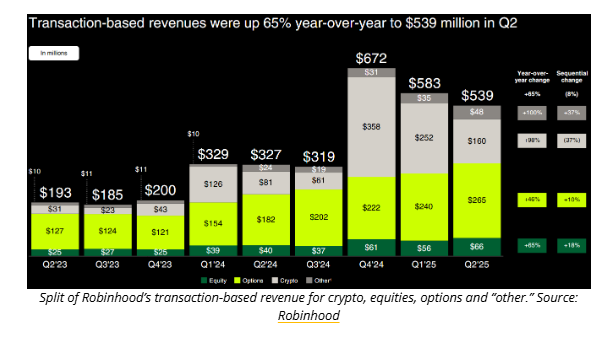
Trading platform Robinhood reported a 98% year-over-year increase in crypto revenue, reaching $160 million in Q2, fueled by growing market activity and its bold push into asset tokenization. CEO Vladimir Tenev confirmed the company’s vision to lead this sector both in the U.S. and international markets.
Crypto Trading Surge Drives Revenue Growth
Robinhood’s total crypto volumes rose 32% to $28 billion in the quarter, as the global crypto market cap jumped 21.7% to $3.36 trillion. The company also reported net revenue of $989 million, up 45%, and a 105% increase in net income to $386 million.
Despite outperforming expectations, Robinhood shares dipped slightly in after-hours trading.
The breakdown of transaction-based revenues shows crypto as one of the fastest-growing verticals, outpacing traditional asset classes like equities and options.
Real-World Asset Tokenization Becomes Core Focus
Tenev described tokenization as the industry’s biggest innovation in a decade, stating that Robinhood aims to unlock access to alternative assets that were previously off-limits to retail investors.
“We’re focused on tokenizing private markets and real-world assets,” he said, referencing assets like venture capital funds, private equity, and real estate.
To support this, Robinhood recently launched Robinhood Chain, a tokenization-focused layer 2 blockchain in Europe, and acquired crypto exchange Bitstamp for $200 million—key moves in its global tokenization rollout.
Developer Interest and Legal Challenges
Since unveiling its tokenization strategy in Cannes, Robinhood has received a surge of interest from developers eager to tokenize company shares and real-world assets.
Private equity tokens resembling companies like OpenAI and SpaceX have already been issued in Europe, though some offerings have drawn legal scrutiny—particularly in Lithuania and from companies disputing token authenticity.
Robinhood’s Competitive Edge in Tokenization
Tenev argues that Robinhood is uniquely positioned to scale tokenized finance, thanks to its 25 million U.S. users and $1 trillion in assets under custody.
“No one else is directly targeting real-world asset tokenization at this scale,” he said, contrasting Robinhood with layer 2 platforms focused mainly on DeFi and speculative trading.
While Ethereum remains dominant in real-world asset tokenization, Robinhood’s strategic infrastructure and regulatory focus may offer a competitive advantage in shaping the future of on-chain finance.
Disclaimer
This content is for informational purposes only and does not constitute financial, investment, or legal advice. Cryptocurrency trading involves risk and may result in financial loss.