
The United States Securities and Exchange Commission has issued updated guidance creating a taxonomy for digital assets, marking a significant shift from former Chairman Gary Gensler’s regulatory approach. The guidance categorizes digital assets into five classes: digital commodities, digital collectibles like NFTs, digital tools, stablecoins, and tokenized securities. Under this framework, most cryptocurrencies and tokens are classified as non securities, providing clarity to the market and regulators.
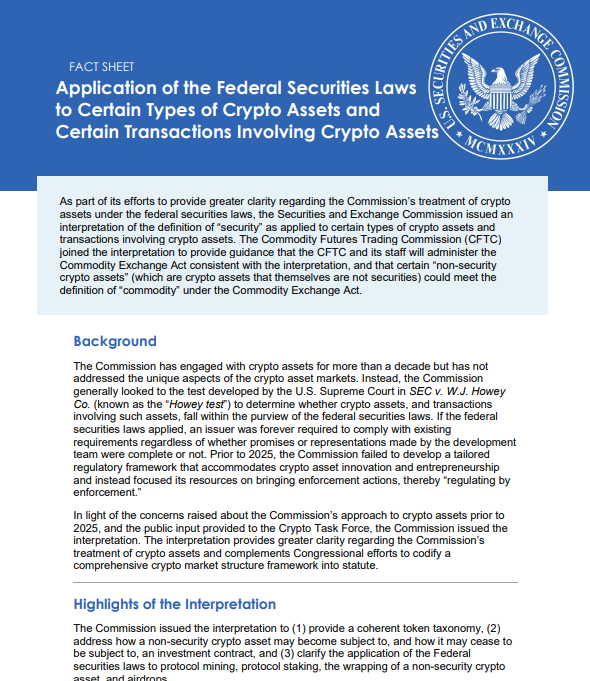
Unlike previous legislative rules, the new interpretive guidance does not require notice-and-comment rulemaking and does not carry the force of law. This allows the SEC and market participants greater flexibility to adapt regulations without binding courts to enforce them, according to analysts.
Impact on the Crypto Industry and CLARITY Act
The guidance offers 30 months of regulatory clarity for cryptocurrency firms, though experts note that the CLARITY Act must still be codified to establish long-term rules. The CLARITY bill stalled in January 2025 over concerns regarding stablecoin yield restrictions and potential reporting requirements for decentralized finance platforms. Recent reports suggest a tentative deal between the White House and lawmakers could advance the bill, potentially including a ban on stablecoin yield from passive balances.
This regulatory update is viewed as a pivotal moment for U.S. crypto policy, effectively closing the Gensler-era approach while setting a framework for the future of digital asset regulation.
Disclaimer
This content is for informational purposes only and does not constitute financial, investment, or legal advice. Cryptocurrency trading involves risk and may result in financial loss.