

$400 Million in Seized Cryptocurrency Now Sits in Government-Controlled Cold Storage

The U.S. Secret Service has accumulated nearly $400 million in cryptocurrency through years of cybercrime investigations, forming one of the largest cold wallets globally controlled by a law enforcement agency.

This massive cache, quietly built over the past decade, highlights how the agency has adapted its financial crime division to the blockchain era. According to officials familiar with the matter, much of the seized digital assets are stored in a single cold-storage wallet, ensuring maximum security against theft or cyberattack.
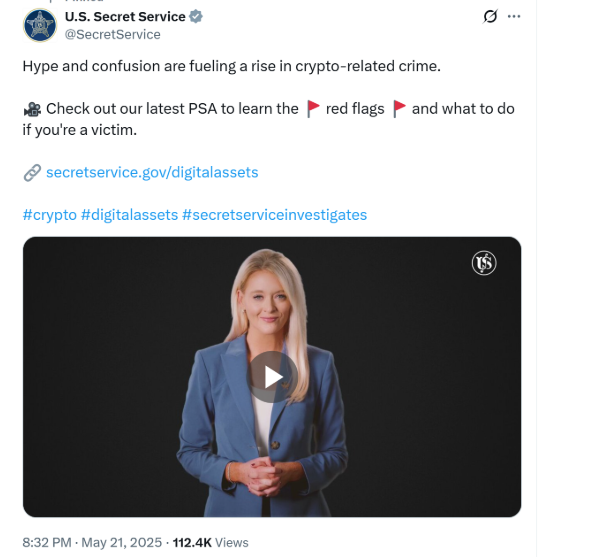
Blockchain Forensics and VPN Mistakes Help Unmask Criminals

The agency’s Global Investigative Operations Center (GIOC), led by digital crime expert Kali Smith, relies on open-source intelligence tools, blockchain tracking, and network analysis to investigate fraud. One of their key advantages lies in tracing crypto transactions that many scammers assume are untraceable.

In several investigations, VPN failures exposed real IP addresses, leading authorities directly to suspects. In other cases, wallet-to-wallet transfers left clear transaction trails, allowing analysts to reconstruct fraudulent operations involving stolen funds, digital extortion, and scam platforms.

Romance Scams and Sextortion Among Common Fraud Types

One tactic the Secret Service repeatedly uncovered involves romance-investment scams. Criminals lure victims into crypto “investment” sites, which initially show profits before suddenly disappearing with the victim’s funds.

In another alarming case, an Idaho teenager was extorted through a sextortion scheme. The digital trail led agents from the victim to a coerced “money mule,” and then to a wallet tied to over $4.1 million in illicit transactions. The suspected perpetrator was later arrested in the UK and awaits extradition.

Crypto Scams Now Lead Internet Crime Losses in the U.S.

According to FBI statistics, crypto fraud led all internet-related financial crimes in 2024, accounting for over $9.3 billion in reported losses—more than half of the year’s total internet crime damage. In the first half of 2025 alone, hack-related losses and crypto scams have already topped $2.47 billion, a 3% increase from the same period last year.

Conclusion: Law Enforcement Goes Digital

As blockchain adoption grows, crypto crime investigations are becoming central to financial security enforcement. With hundreds of millions in seized digital assets under its control, the Secret Service is now not only tracking criminals but also holding one of the largest crypto wallets on Earth.

Disclaimer

This content is for informational purposes only and does not constitute financial, investment, or legal advice. Cryptocurrency trading involves risk and may result in financial loss

logo

blockto.io

info@blockto.io

Blockto.io Copyright © 2025, All rights reserved

News
Rates
Buy
More
We use cookies to personalize content and ads, provide social media features, and analyze our traffic. In accordance with GDPR/AVG and EU cookie regulations, data is processed only with your consent. We may share information about your use of our website with our social media, advertising, and analytics partners, and you can manage or withdraw your consent at any time. View more
Cookies settings
Accept
Privacy & Cookie policy
Privacy & Cookies policy
Cookie name Active

Privacy Policy

At BitxJournal.com, we respect your privacy and are committed to protecting your personal data. This Privacy Policy explains how we collect, process, store, and protect personal information in accordance with the General Data Protection Regulation (GDPR) and AVG (EU privacy legislation).

1. Data Controller

BitxJournal.com acts as the data controller for all personal data processed through this website.

2. Personal Data We Collect

We may collect and process the following categories of data:

Personal Data

  • Name and email address (when you subscribe to newsletters or contact us)

Technical & Usage Data

  • IP address, browser type, operating system

  • Device information

  • Pages visited, referral sources, and interaction data

This data is collected via cookies, log files, and analytics technologies.

3. Legal Basis for Processing

We process personal data only when a lawful basis exists, including:

  • Consent – when you explicitly agree (e.g., cookies, newsletter sign-up)

  • Legitimate interest – to operate, secure, and improve our website

  • Legal obligation – when required by applicable laws

You may withdraw your consent at any time.

4. Purpose of Data Processing

Your data is processed for the following purposes:

  • Operating and maintaining the website

  • Improving content, usability, and performance

  • Sending newsletters or updates (only with consent)

  • Analyzing traffic and user behavior

  • Responding to inquiries or support requests

5. Cookies & Consent Management

We use cookies and similar technologies in compliance with EU Cookie Law.

  • Non-essential cookies are placed only after explicit user consent

  • Users may accept, reject, or manage cookie preferences at any time

  • Consent can be withdrawn without affecting prior lawful processing

Detailed cookie information is available in our Cookie Settings panel.

6. Third-Party Data Processing

We may share limited data with trusted third-party service providers, including:

  • Analytics providers (e.g., Google Analytics)

  • Advertising partners (for personalized or non-personalized ads)

These third parties act as data processors and process data only under contractual obligations compliant with GDPR/AVG.

7. International Data Transfers

Where data is transferred outside the European Economic Area (EEA), we ensure appropriate safeguards are in place, such as Standard Contractual Clauses (SCCs) or equivalent legal mechanisms.

8. Data Retention

We retain personal data only for as long as necessary to fulfill the purposes outlined in this policy or as required by law.

9. Data Security

We implement appropriate technical and organizational security measures to protect personal data against unauthorized access, alteration, disclosure, or destruction.

10. Your GDPR Rights

Under GDPR/AVG, you have the right to:

  • Access your personal data

  • Rectify inaccurate or incomplete data

  • Request data erasure (“right to be forgotten”)

  • Restrict or object to processing

  • Data portability

  • Withdraw consent at any time

  • Lodge a complaint with a supervisory authority

11. Changes to This Privacy Policy

We reserve the right to update this Privacy Policy at any time. Any changes will be posted on this page with a revised effective date.

12. Contact Information

For privacy-related inquiries or GDPR requests, contact:

📧 Email: support@blockto.io
🌐 Website: https://blockto.io

Save settings
Cookies settings