
As Bitcoin’s network hashrate pushes near all-time highs, a surprising trend is unfolding—solo miners are managing to secure full block rewards, despite the overwhelming odds. With new advancements in ASIC efficiency and a renewed push for decentralization, solo Bitcoin mining appears to be making a quiet comeback.
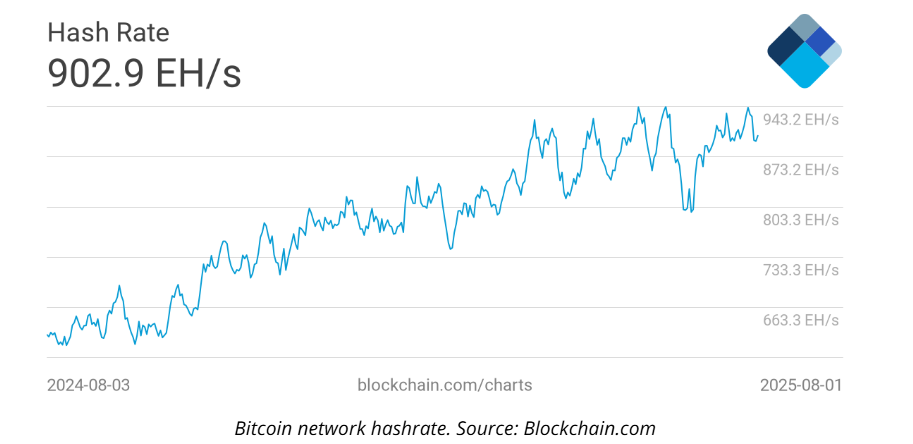
Bitcoin’s Hashrate Near Record Highs
Currently, the Bitcoin network is running at approximately 902 exahashes per second (EH/s)—just under its all-time record. Such high difficulty typically makes it nearly impossible for solo miners to succeed, as the chances of solving a block without pooling resources are extremely low.
Yet, recent examples challenge that assumption.
In late July, a solo miner using the Solo CK mining pool earned the full 3.125 BTC reward—valued at over $370,000—for successfully mining block 907,283. The block also included $3,400 in transaction fees, further boosting the payout.
This wasn’t an isolated event. Several solo miners have successfully claimed block rewards in February, March, June, and earlier in July, all operating far below the hashpower of major mining farms.
ASIC Efficiency and Lower Power Draw Fuel Resurgence
One key reason behind these surprising wins is improved ASIC efficiency. Devices like the KEYMINER A1, X, and PRO are designed to deliver high hashrate with low power consumption—reducing costs while improving competitiveness.
For example, the KEYMINER PRO produces 5,800 TH/s at just 2,800 watts, offering potential monthly earnings of up to $6,300 under current conditions.
“It’s not just about luck anymore. These miners are using seriously powerful equipment,” noted one hardware manufacturer.
Still, solo mining remains a statistical gamble, with a miner holding 1 petahash per second (PH/s) having only a 1 in 650,000 chance to solve a block within 10 minutes.
Beyond Profit: The Push for Decentralization
While some solo miners are driven by hopes of massive one-time rewards, others are motivated by ideology—seeking to restore decentralization in the face of growing mining pool dominance.
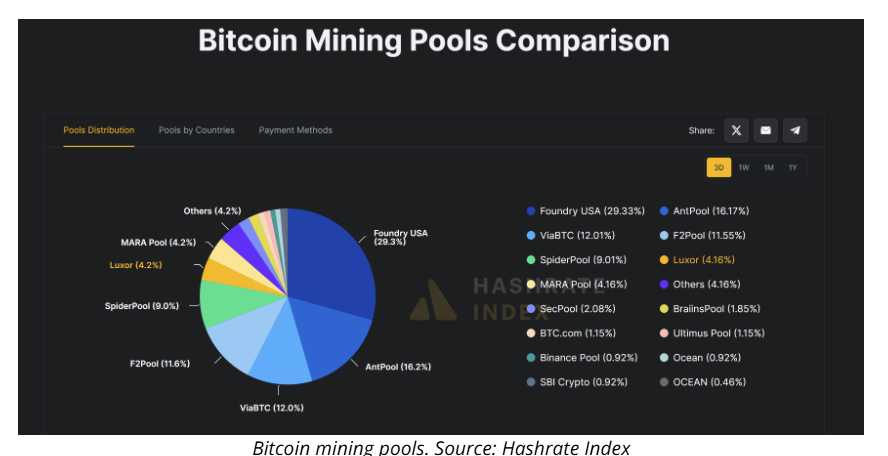
Currently, Foundry USA controls nearly 30% of Bitcoin’s total hashrate. If a few pools exceed 50% control, it raises the risk of a 51% attack, undermining the core trust in Bitcoin’s decentralized nature.
“More solo miners mean a stronger, more resilient Bitcoin network,” experts argue.
Disclaimer
This content is for informational purposes only and does not constitute financial, investment, or legal advice. Cryptocurrency trading involves risk and may result in financial loss.