

Massive Outflows Hit Bitcoin ETFs
U.S. spot Bitcoin exchange-traded funds (ETFs) saw $536.4 million in daily net outflows on Thursday, the largest single-day withdrawal since August 1, according to data from SoSoValue.
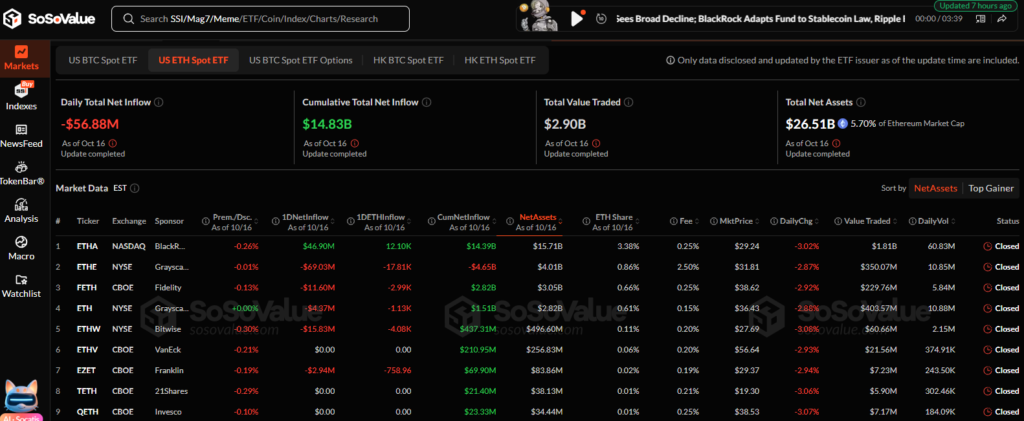
Out of the 12 listed Bitcoin ETFs, eight reported net outflows, led by ARK & 21Shares’ ARKB, which lost $275.15 million, followed by Fidelity’s FBTC with $132 million. Other funds managed by BlackRock, Grayscale, Bitwise, VanEck, and Valkyrie also saw notable investor exits.
Meanwhile, spot Ethereum ETFs posted $56.9 million in net outflows, reversing gains from earlier in the week.
Analysts: ‘A Surge in Risk Aversion’
Nick Ruck, director at LVRG Research, attributed the selloff to a sharp increase in investor caution.
“The $536 million in net outflows primarily reflects a surge in investor risk aversion,” Ruck said. “This caution is likely driven by macroeconomic pressures — particularly evolving U.S. tariff policies — and a broader market deleveraging event that has triggered liquidations across crypto assets.”
The latest ETF withdrawals align with a $20 billion crypto liquidation event that has impacted over 1.5 million traders since last Friday.
The crash was sparked by U.S. President Donald Trump’s 100% tariffs on Chinese imports, a move that rattled global markets and sent risk assets — including crypto — into a tailspin.
Geopolitics, Monetary Policy Add Pressure
Market analysts warned that ETF outflows highlight short-term fragility in the crypto space.
“ETF outflows are a signal of near-term market weakness,” Ruck said. “Until uncertainty clears, we may see additional downward pressure.”
Justin d’Anethan, Head of Research at Arctic Digital, agreed that while the market seeks stability, unresolved forces continue to weigh heavily:
“The market wants to stabilize,” d’Anethan explained. “But it’s still grappling with geopolitical uncertainty and the lingering effects of restrictive monetary policy that hasn’t yet pivoted.”
Crypto prices followed ETF flows lower on Thursday:
Despite short-term volatility, d’Anethan said there are reasons for cautious optimism:
“Structurally, inflation is softening and central banks are nearing their pivot point,” he said. “But until CPI data and policy statements confirm that shift — or geopolitical tensions ease — expect volatility to remain high.”
Disclaimer
This content is for informational purposes only and does not constitute financial, investment, or legal advice. Cryptocurrency trading involves risk and may result in financial loss.