

As MSCI weighs excluding digital-asset treasury firms, Strategy’s stock plunges while its chairman defends the company’s operational model.
Strategy’s sharp share-price decline has stirred investor anxiety, but chairman Michael Saylor is pushing back against speculation that the company could be sidelined from key global equity indices. With MSCI reviewing whether firms with large digital-asset treasuries should be excluded, Strategy now finds itself at the center of a debate over how Bitcoin-heavy public companies should be classified. Despite the scrutiny, Saylor insists the firm’s identity and long-term strategy remain intact.
MSCI Review Sparks Concerns Among Strategy Investors
MSCI announced last month that it is evaluating whether to remove companies that hold substantial digital-asset treasuries from its benchmarks. A decision is expected by January 15, 2026. Strategy is currently included in the Nasdaq-100, MSCI USA, and MSCI World, making any exclusion potentially significant.
JPMorgan analysts estimate the impact could be substantial, writing that Strategy may face $2.8 billion in outflows if removed — and as much as $8.8 billion if other index providers follow.
The analysts warned that passive index trackers account for a meaningful share of Strategy’s total ownership, creating an added layer of vulnerability should removal occur.
Saylor Rejects the Idea That Strategy Is a Simple Bitcoin Proxy
Responding to the concerns, Saylor emphasized that the company is far more than a large Bitcoin balance sheet.
“Strategy is not a fund, not a trust, and not a holding company,” he said. “We’re a publicly traded operating company with a $500 million software business and a unique treasury strategy that uses Bitcoin as productive capital.”
He added that index classification does not define the company’s identity, stressing that its long-term mission goes beyond passive ownership:
“Our conviction in Bitcoin is unwavering, and our mission remains unchanged: to build the world’s first digital monetary institution on a foundation of sound money and financial innovation.”
Stock Continues to Slide Despite Aggressive Bitcoin Accumulation
The company has continued accumulating BTC even as the market weakens. Its latest acquisition brings the treasury to 649,870 BTC, purchased for about $48.4 billion, representing over 3% of Bitcoin’s total supply.
Yet, selling pressure on the stock persists. MSTR is down nearly 44% over the past month and more than 13% over the past week, recently trading near $173.50, far below its July peak above $450.
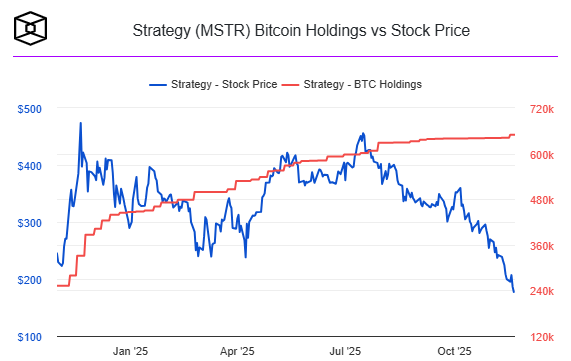
JPMorgan attributes the broader downturn in Bitcoin — now down roughly 24% over the past month — largely to retail selling in spot BTC and ETH ETFs, amplifying pressure on institutions with large crypto exposure.
While Strategy faces a critical classification decision from MSCI, its leadership is signaling no shift in direction. The company continues to expand its Bitcoin position even as share prices fall, reaffirming a long-term strategy that Saylor insists is aligned with the future of digital monetary infrastructure.
Disclaimer
This content is for informational purposes only and does not constitute financial, investment, or legal advice. Cryptocurrency trading involves risk and may result in financial loss.