
A Government Shutdown Clouds the Fed’s Path
The Federal Reserve’s next interest rate decision on October 29 is shaping up to be one of the most consequential events of the year — and possibly one of the most unpredictable.
A partial U.S. government shutdown, which began on October 1, has delayed crucial economic reports such as the September jobs data from the Bureau of Labor Statistics (BLS). Without this key input, the Fed faces the rare challenge of making a rate call with limited visibility into the health of the labor market.
This “data blackout” comes at a time when inflation remains stubborn, while markets are priced for continued policy easing. The result: heightened uncertainty across both Wall Street and crypto markets.
Markets Expect a 25-Basis-Point Cut — But the Fed May Pause
According to CME Group’s FedWatch Tool, traders assign a 96.2% probability of a 25 basis-point rate cut at the upcoming Federal Open Market Committee (FOMC) meeting, with only 3.8% odds for no change.
Decentralized prediction markets such as Polymarket also reflect strong expectations of a modest cut — with just a small chance of a pause or hike.
However, this consensus might be too one-sided.
With no official jobs data and uncertainty about the true state of wage growth, some Fed policymakers may argue that cutting too aggressively could reignite inflation. Historically, the central bank has preferred caution during data gaps, opting to pause rather than risk policy mistakes.
Shutdown Risks and Market Sensitivity
The ongoing shutdown adds a second layer of risk.
Roughly 800,000 federal workers face temporary furloughs, while halted contracts and delayed data could drag on short-term growth.
Yet the Fed has little clarity on how severe that drag might be — a scenario that could justify holding rates steady temporarily.
This creates a delicate balance.
Many investors have built portfolios around continued rate cuts, pushing the Dow Jones and S&P 500 to record highs at 46,758.28 and 6,715.79, respectively.
A surprise pause or hawkish tone from the Fed could trigger a sharp correction in both equities and digital assets, which currently trade at elevated valuations.
Crypto and Gold at Record Highs Amid Policy Uncertainty
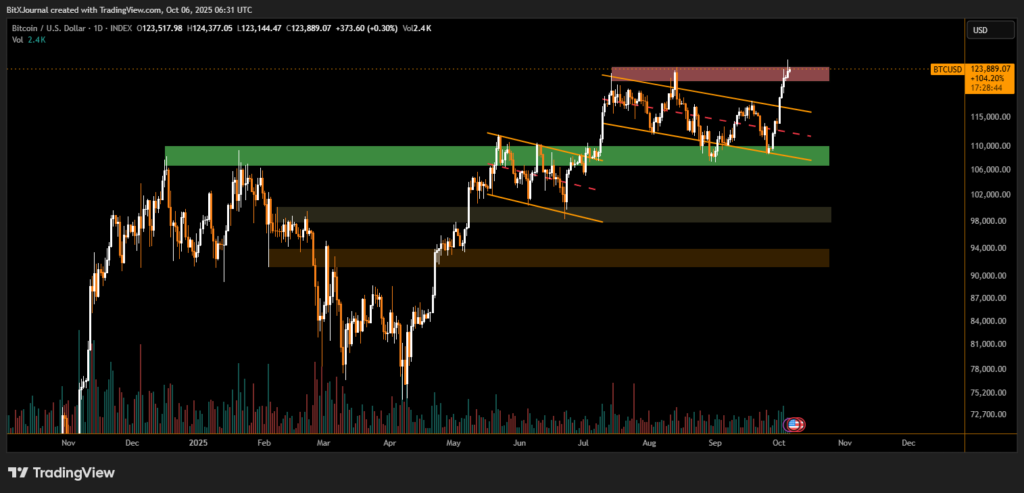
Bitcoin remains near its all-time high of $125,506, recently trading around $123,196, buoyed by institutional inflows and ETF demand.
Gold, meanwhile, closed at $3,886 per ounce, up 48% year-to-date, reflecting central bank buying and investor hedging against inflation and fiscal stress.
These price surges suggest that markets are already positioning for monetary easing — meaning any deviation from that expectation could trigger a broad risk-off move.
A larger, 50-basis-point rate cut appears nearly impossible under current conditions.
Inflation remains above 2%, particularly in services where wage pressures persist, and an aggressive cut could undermine the Fed’s inflation-fighting credibility.
What to Watch Before Oct. 29
In the absence of federal data, private and regional Fed surveys will offer the only clues to current economic conditions.
If those reports show slowing growth and cooling inflation, the Fed may proceed with the expected 25 bps cut.
But if inflation indicators stay firm, policymakers may pause rate cuts, setting up a volatile reaction across stocks, bonds, Bitcoin, and gold.
The Oct. 29 FOMC meeting may not deliver the straightforward rate cut investors anticipate.
With data disruptions, inflation risks, and a fragile market narrative, the Fed’s next move could determine whether the year ends with another market rally — or a sharp reversal across U.S. and crypto assets.
Disclaimer
This content is for informational purposes only and does not constitute financial, investment, or legal advice. Cryptocurrency trading involves risk and may result in financial loss.