
Tokenized real-world assets (RWAs), excluding stablecoins, have surged to over $25 billion in onchain value, nearly quadrupling from $6.4 billion a year ago, according to RWA.xyz data. The growth highlights a shift from experimentation to institutional-scale deployment, with asset managers including BlackRock, Fidelity, and WisdomTree launching tokenized fund products.
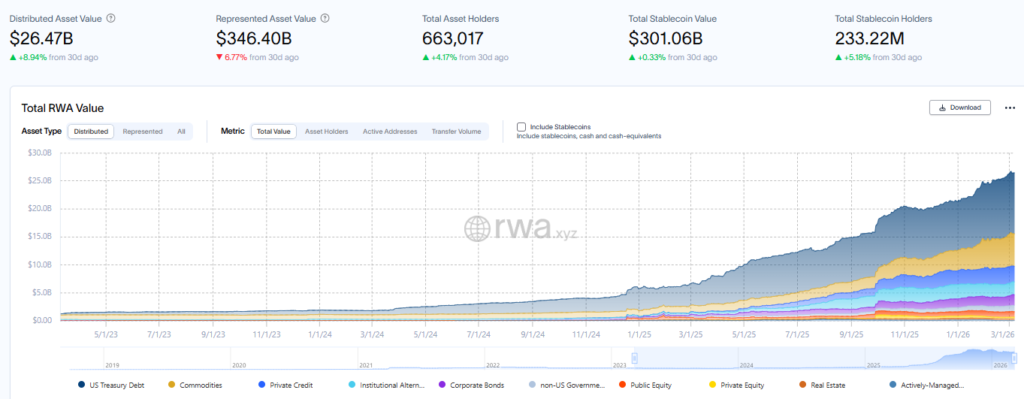
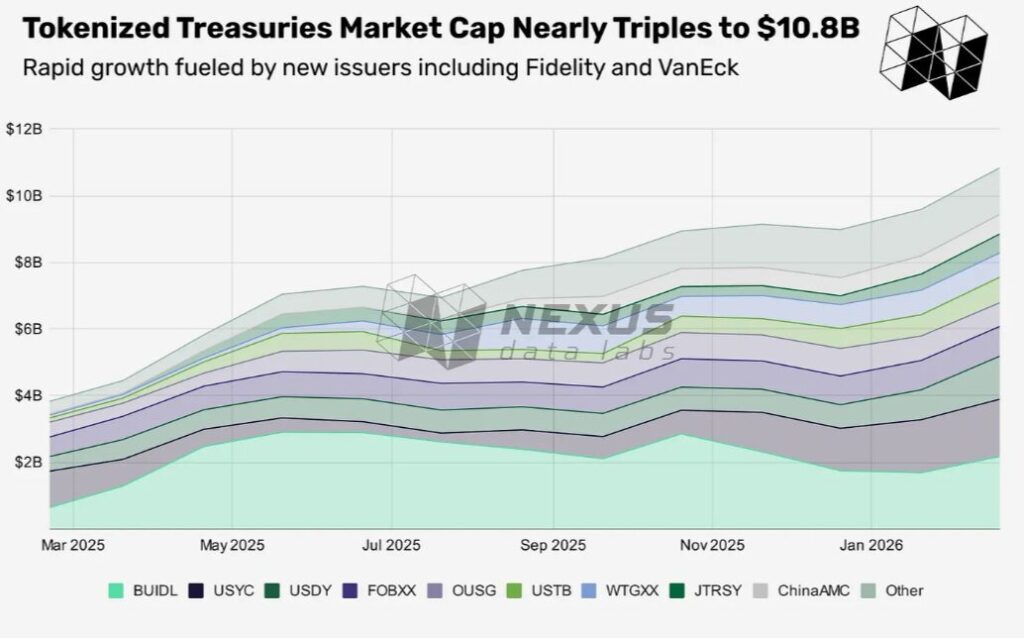
Six categories now exceed $1 billion each, including U.S. Treasuries, commodities, private credit, institutional alternative funds, corporate bonds, and non-U.S. government debt. The number of tokenized U.S. Treasury offerings alone increased from 35 to more than 50 in the past year, signaling growing institutional adoption.
Issuance Drives Growth, Not Trading
Despite the surge in supply, most activity reflects capital issuance rather than active secondary trading. Onchain data shows many of the largest RWA transactions cluster around $10 million per transfer, indicating institutional allocation batching. A survey from tokenization platform Brickken found that 53.8% of issuers prioritize capital formation and fundraising efficiency, while only 15.4% cited liquidity as the main motivation.
Limited DeFi Integration
Although tokenized asset supply is growing rapidly, most remains siloed from decentralized finance. Of the roughly $8.49 billion in RWA backed stablecoins, only about $1 billion (12%) is deployed in DeFi protocols. Compliance requirements, such as KYC, transfer restrictions, and whitelisting, limit broader integration.
The sector faces a critical question: whether tokenized assets will remain permissioned and isolated or integrate into DeFi’s composable lending and trading systems. Market projections suggest that tokenized assets could exceed $400 billion by year-end, depending on how integration with DeFi evolves.
Disclaimer
This content is for informational purposes only and does not constitute financial, investment, or legal advice. Cryptocurrency trading involves risk and may result in financial loss.