As artificial intelligence advances rapidly, concerns over widespread job loss are gaining traction. However, David Sacks, the appointed AI and crypto advisor under Donald Trump’s campaign, is pushing back, calling these concerns exaggerated.
AI Still Needs Human Oversight to Drive Business Value
Sacks argued that AI does not replace human labor entirely but instead performs “middle-to-middle” tasks that still require human prompting, oversight, and verification. In a recent statement, he emphasized that business outcomes depend on human management of AI workflows, not full automation.
Microsoft Study Flags Roles at Risk
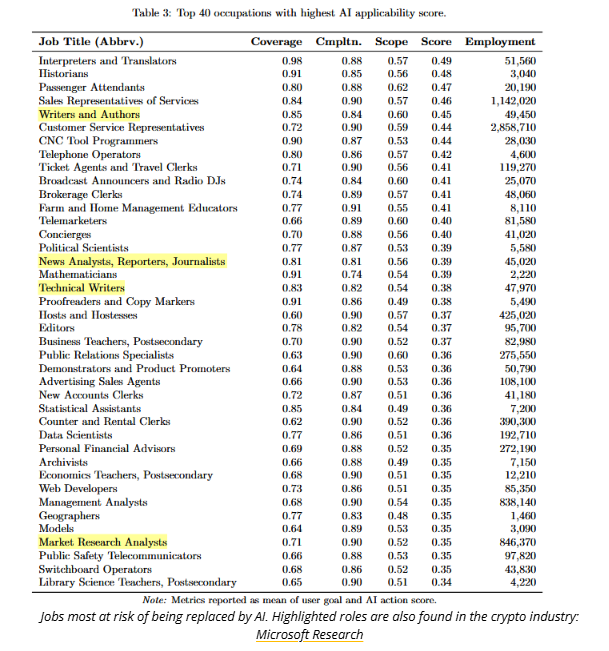
A recent Microsoft Research study analyzed over 200,000 real-world Copilot chats to assess which jobs AI is most likely to impact. It revealed that reporters, journalists, and technical writers—roles also found within the crypto industry—could be significantly affected.
- Customer service representatives also ranked high on the list.
- Reporting and writing roles scored 0.38–0.39 on the AI applicability index.
- Data-driven roles like data scientists and market research analysts scored lower at 0.35–0.36, signaling less vulnerability.
These findings highlight how information-gathering and content-generation tasks are more susceptible to automation than technical or analytical functions.

Crypto Sector Feels the Pressure
The impact on the crypto job market is already visible. In July:
- Only 38 jobs were added to CryptoJobsList.com
- Remote3.co posted just 69 new roles
This slowdown aligns with broader U.S. labor trends—only 73,000 new jobs were added in July, well below estimates.
“AI Doesn’t Take Your Job—It Upgrades It”
Sacks cited Balaji Srinivasan, a leading crypto entrepreneur, who believes AI enhances human productivity rather than replaces it. According to Balaji, AI replaces older AI models—not humans:
“Midjourney replaced Stable Diffusion. GPT-4 replaced GPT-3. You don’t lose your job—you get a better tool.”
This reflects a growing sentiment that AI evolution mirrors software upgrades, where tools become more efficient but still need users to operate them.
Final thoughts
While fears about AI-led job loss continue to make headlines, industry leaders like David Sacks believe the AI-human relationship is more collaborative than competitive. As AI becomes more embedded in workflows, its role appears to be enhancing output—not replacing people entirely.
Disclaimer
This content is for informational purposes only and does not constitute financial, investment, or legal advice. Cryptocurrency trading involves risk and may result in financial loss.