
Key Crypto Tax Reforms Proposed in Amendment

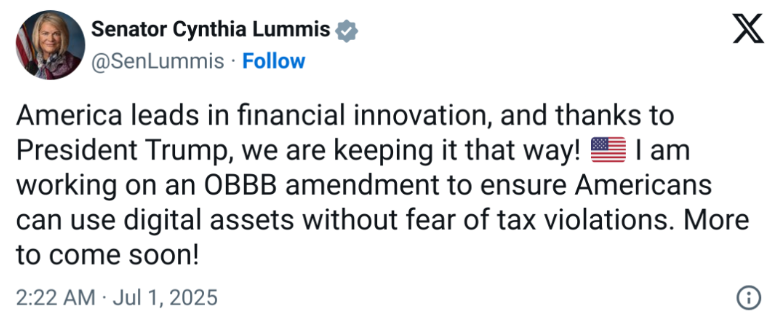
significant crypto tax measure is being introduced into the U.S. budget bill, aiming to reduce tax burdens on small-scale cryptocurrency transactions and core industry activities. The amendment, led by Senator Cynthia Lummis, seeks to exempt transactions under $300 from taxation while addressing critical issues in staking, mining, and crypto lending.

Tax Relief for Small Crypto Transactions

The proposed amendment includes a de minimis exemption, eliminating taxes on crypto transactions below $300, with an annual cap of $5,000. This change would simplify tax reporting for casual users, removing the need to calculate capital gains on minor transactions. Supporters argue this could encourage broader crypto adoption by reducing compliance hurdles.
Fixing Double Taxation in Staking and Mining

One of the most pressing issues in crypto taxation is the double taxation of staking and mining rewards. Currently, rewards are taxed:

  1. Upon receipt (as income)
  2. Upon sale (as capital gains)

The amendment proposes taxing these rewards only at the point of sale, aligning taxation with actual realized income. This change would benefit:

  • Stakers (who earn rewards for securing blockchain networks)
  • Miners (who receive newly minted coins)
  • Airdrop and fork recipients

Closing the Crypto Wash Sale Loophole

Another key provision targets wash trading, a strategy where investors sell assets at a loss and immediately repurchase them to claim tax deductions. Unlike traditional securities, crypto currently allows this practice. The amendment seeks to close this loophole, ensuring fairer tax treatment.

Political Challenges and Budget Impact

The amendment is part of a broader Senate budget negotiation, facing opposition due to concerns over Medicaid cuts and increased deficit spending. Analysts estimate the bill could add over $3 trillion to the national deficit.

Next Steps for the Legislation

  • The Senate must vote on the amendment in the ongoing “vote-a-rama” process.
  • If approved, the House of Representatives will need to re-pass the revised bill.
  • Industry advocates are urging public support to push the amendment forward.

Why This Matters for Crypto Users

If passed, these changes could:
 Reduce tax complexity for small crypto transactions
 Eliminate double taxation on staking and mining
 Prevent tax avoidance through wash sales

The proposal marks a major step toward clearer, fairer crypto tax policies in the U.S. Stakeholders are closely watching as the Senate debates the bill’s future.

Disclaimer

This content is for informational purposes only and does not constitute financial, investment, or legal advice. Cryptocurrency trading involves risk and may result in financial loss.

logo

blockto.io

info@blockto.io

Blockto.io Copyright © 2025, All rights reserved

News
Rates
Buy
More
We use cookies to personalize content and ads, provide social media features, and analyze our traffic. In accordance with GDPR/AVG and EU cookie regulations, data is processed only with your consent. We may share information about your use of our website with our social media, advertising, and analytics partners, and you can manage or withdraw your consent at any time. View more
Cookies settings
Accept
Privacy & Cookie policy
Privacy & Cookies policy
Cookie name Active

Privacy Policy

At BitxJournal.com, we respect your privacy and are committed to protecting your personal data. This Privacy Policy explains how we collect, process, store, and protect personal information in accordance with the General Data Protection Regulation (GDPR) and AVG (EU privacy legislation).

1. Data Controller

BitxJournal.com acts as the data controller for all personal data processed through this website.

2. Personal Data We Collect

We may collect and process the following categories of data:

Personal Data

  • Name and email address (when you subscribe to newsletters or contact us)

Technical & Usage Data

  • IP address, browser type, operating system

  • Device information

  • Pages visited, referral sources, and interaction data

This data is collected via cookies, log files, and analytics technologies.

3. Legal Basis for Processing

We process personal data only when a lawful basis exists, including:

  • Consent – when you explicitly agree (e.g., cookies, newsletter sign-up)

  • Legitimate interest – to operate, secure, and improve our website

  • Legal obligation – when required by applicable laws

You may withdraw your consent at any time.

4. Purpose of Data Processing

Your data is processed for the following purposes:

  • Operating and maintaining the website

  • Improving content, usability, and performance

  • Sending newsletters or updates (only with consent)

  • Analyzing traffic and user behavior

  • Responding to inquiries or support requests

5. Cookies & Consent Management

We use cookies and similar technologies in compliance with EU Cookie Law.

  • Non-essential cookies are placed only after explicit user consent

  • Users may accept, reject, or manage cookie preferences at any time

  • Consent can be withdrawn without affecting prior lawful processing

Detailed cookie information is available in our Cookie Settings panel.

6. Third-Party Data Processing

We may share limited data with trusted third-party service providers, including:

  • Analytics providers (e.g., Google Analytics)

  • Advertising partners (for personalized or non-personalized ads)

These third parties act as data processors and process data only under contractual obligations compliant with GDPR/AVG.

7. International Data Transfers

Where data is transferred outside the European Economic Area (EEA), we ensure appropriate safeguards are in place, such as Standard Contractual Clauses (SCCs) or equivalent legal mechanisms.

8. Data Retention

We retain personal data only for as long as necessary to fulfill the purposes outlined in this policy or as required by law.

9. Data Security

We implement appropriate technical and organizational security measures to protect personal data against unauthorized access, alteration, disclosure, or destruction.

10. Your GDPR Rights

Under GDPR/AVG, you have the right to:

  • Access your personal data

  • Rectify inaccurate or incomplete data

  • Request data erasure (“right to be forgotten”)

  • Restrict or object to processing

  • Data portability

  • Withdraw consent at any time

  • Lodge a complaint with a supervisory authority

11. Changes to This Privacy Policy

We reserve the right to update this Privacy Policy at any time. Any changes will be posted on this page with a revised effective date.

12. Contact Information

For privacy-related inquiries or GDPR requests, contact:

📧 Email: support@blockto.io
🌐 Website: https://blockto.io

Save settings
Cookies settings