

U.S. spot Bitcoin exchange-traded funds (ETFs), which had recently seen massive inflows, are now witnessing a wave of investor withdrawals. After hitting record cumulative inflows in recent months, these funds logged a notable $96 million in net outflows — signaling a shift in market sentiment amid Bitcoin’s price volatility.
From Record Inflows to Sudden Reversals
The U.S. spot Bitcoin ETF market began 2025 with explosive momentum. January saw inflows of nearly $4.8 billion as institutional investors rushed to gain regulated exposure to Bitcoin. These ETFs, approved by the SEC in early 2024, provided an accessible way for traditional investors to enter the crypto market.
However, the enthusiasm has cooled. February marked a stark reversal, with outflows gaining momentum. On February 25, a record $938 million exited the market in a single day — the largest outflow since the products were launched. The $96 million daily net outflow that followed underscores this emerging bearish trend.
Major ETFs Leading the Withdrawals
Several top funds were hit hard during the sell-off. Fidelity’s Wise Origin Bitcoin Fund (FBTC) recorded the largest single-day outflow of $344.7 million. Even BlackRock’s popular iShares Bitcoin Trust (IBIT), once leading in inflows, experienced $164.4 million in outflows.
Bitwise’s BITB ETF saw $88.3 million withdrawn, while Grayscale’s converted GBTC logged $151.9 million in redemptions. These movements suggest that even the strongest-performing ETFs aren’t immune to sudden sentiment shifts.
What’s Driving the Outflows?
Market analysts point to several factors contributing to the ETF exodus. Primarily, Bitcoin’s price correction has made arbitrage opportunities less attractive for hedge funds that initially fueled the ETF boom. As prices pull back, traders exit positions to secure profits or cut losses.
On February 25, Bitcoin fell over 3.4%, hitting a 24-hour low of $86,140. Such volatility tends to ripple into ETF markets, especially those heavily influenced by algorithmic or short-term trading strategies.
Additionally, the sharp price drops may have triggered stop-loss thresholds for institutional investors, further accelerating the withdrawals.
Short-Term Pain, Long-Term Potential
Despite recent outflows, the broader picture still reflects strong institutional interest. As of early March, net inflows year-to-date remain positive, thanks to a strong January. Analysts also emphasize that such market cycles are normal in emerging asset classes.
The presence of consistent inflows earlier this year proves that traditional investors are increasingly comfortable with Bitcoin exposure, especially when offered through familiar investment vehicles like ETFs.
Bitcoin Price Holds Above $100K Amid Volatility
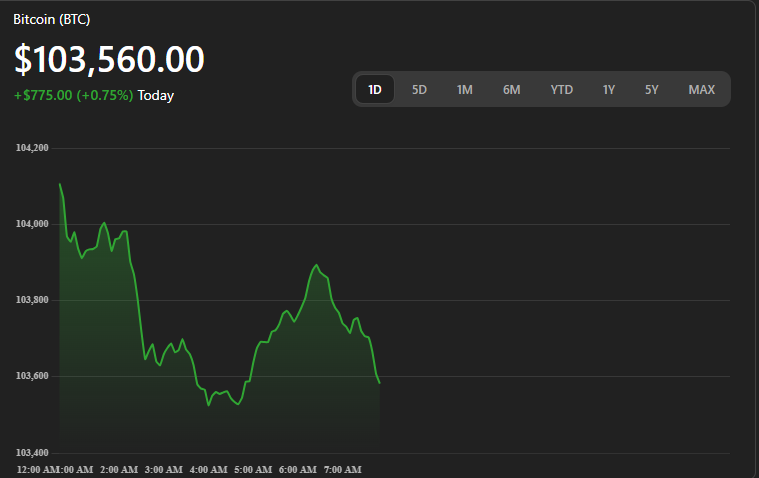
While ETF activity affects sentiment, Bitcoin itself remains resilient. As of May 14, 2025, Bitcoin is trading at $103,560 — up 0.75% from the previous day. The cryptocurrency reached an intraday high of $104,836 and a low of $102,641, indicating continued but controlled volatility.
The $100K level is now seen as a critical psychological and technical support. Whether ETF outflows continue will likely depend on Bitcoin’s ability to maintain this price region in the coming weeks.
Conclusion: A Market in Maturation
The recent $96 million outflow from U.S. spot Bitcoin ETFs marks a turning point after months of record-breaking inflows. While short-term volatility has spooked some investors, the structural foundation of the ETF market remains intact.
These ETFs have opened the door for institutional adoption of Bitcoin, and temporary sell-offs are part of a natural market cycle. As the market matures, both price action and ETF flows will likely stabilize — setting the stage for the next phase of growth in regulated crypto investments.