

US Bankers Urge Delay on Crypto Firms’ Charter Decisions

Major U.S. banking and credit union groups are calling on federal regulators to delay decisions on bank license applications submitted by crypto companies. In a formal request to the Office of the Comptroller of the Currency (OCC), these groups argue that granting national bank charters to crypto firms such as Circle and Ripple Labs would mark a significant shift in policy.

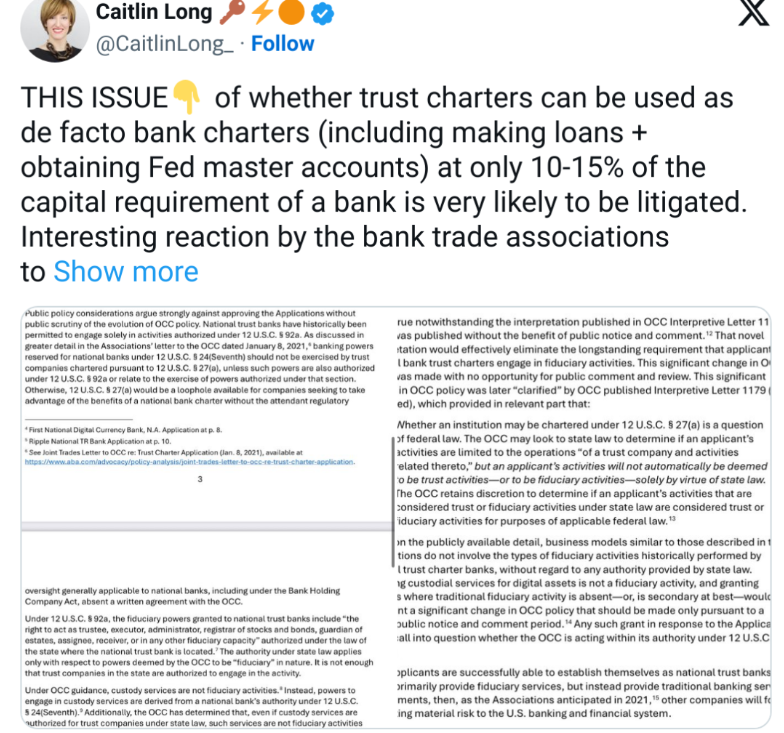
“There are legal and policy questions regarding whether the applicants’ plans fall under fiduciary activities historically performed by trust banks,” stated the letter. The pushback centers on the concern that crypto business models differ sharply from traditional banking structures.

Crypto Companies Aim for Federal Banking Status

Crypto firms including Circle, Ripple, and Fidelity Digital Assets have recently applied for national trust bank charters. If approved, this would allow them to operate federally, eliminating the need for multiple state-level licenses, and offering services such as payment settlement and digital asset custody.

Obtaining a federal charter would enable these firms to function as banks, without the capital or regulatory obligations that conventional banks face.

However, banking groups argue that the public disclosures of the applications are insufficient, and that the OCC must allow for broader public comment before any decision is made.


Concerns Over Stability and Competitive Fairness

One of the core objections is that providing custody of digital assets is not a fiduciary activity by definition. Therefore, granting trust bank charters for such functions would represent a break from decades of precedent.

The banking groups warn that approving such charters could create systemic risks, potentially allowing a wave of nontraditional firms to offer banking services with lighter oversight.

They argue this could allow entities to enter banking with a fraction of the capital requirements traditional banks must meet — potentially creating competitive imbalances and regulatory arbitrage.


Legal Action Could Follow If OCC Proceeds

Industry watchers believe the issue could escalate into litigation. Custodia Bank founder Caitlin Long highlighted the tension, noting that if crypto firms are approved for these charters, traditional banks may be incentivized to convert into trust companies, operating under lighter regulation.

“This could open a back door into full-service banking without full regulation,” Long warned.


Stablecoin Laws Drive Demand for Bank Licenses

Legal experts believe the newly passed GENIUS Act, which introduces a federal stablecoin framework, is pushing stablecoin issuers to seek bank charters.

Although the new license allows stablecoin issuance, it limits broader activity and still requires state-by-state compliance. A national trust bank charter would eliminate these hurdles, enabling crypto firms to operate nationwide and expand services.


Final Thoughts

The ongoing clash between traditional finance and crypto firms over federal banking access highlights growing tensions as digital assets push deeper into regulated spaces.

Whether the OCC proceeds or delays, the outcome of this challenge could reshape the structure of both traditional and digital banking in the United States.

Disclaimer

This content is for informational purposes only and does not constitute financial, investment, or legal advice. Cryptocurrency trading involves risk and may result in financial loss.

logo

blockto.io

info@blockto.io

Blockto.io Copyright © 2025, All rights reserved

News
Rates
Buy
More
We use cookies to personalize content and ads, provide social media features, and analyze our traffic. In accordance with GDPR/AVG and EU cookie regulations, data is processed only with your consent. We may share information about your use of our website with our social media, advertising, and analytics partners, and you can manage or withdraw your consent at any time. View more
Cookies settings
Accept
Privacy & Cookie policy
Privacy & Cookies policy
Cookie name Active

Privacy Policy

At BitxJournal.com, we respect your privacy and are committed to protecting your personal data. This Privacy Policy explains how we collect, process, store, and protect personal information in accordance with the General Data Protection Regulation (GDPR) and AVG (EU privacy legislation).

1. Data Controller

BitxJournal.com acts as the data controller for all personal data processed through this website.

2. Personal Data We Collect

We may collect and process the following categories of data:

Personal Data

  • Name and email address (when you subscribe to newsletters or contact us)

Technical & Usage Data

  • IP address, browser type, operating system

  • Device information

  • Pages visited, referral sources, and interaction data

This data is collected via cookies, log files, and analytics technologies.

3. Legal Basis for Processing

We process personal data only when a lawful basis exists, including:

  • Consent – when you explicitly agree (e.g., cookies, newsletter sign-up)

  • Legitimate interest – to operate, secure, and improve our website

  • Legal obligation – when required by applicable laws

You may withdraw your consent at any time.

4. Purpose of Data Processing

Your data is processed for the following purposes:

  • Operating and maintaining the website

  • Improving content, usability, and performance

  • Sending newsletters or updates (only with consent)

  • Analyzing traffic and user behavior

  • Responding to inquiries or support requests

5. Cookies & Consent Management

We use cookies and similar technologies in compliance with EU Cookie Law.

  • Non-essential cookies are placed only after explicit user consent

  • Users may accept, reject, or manage cookie preferences at any time

  • Consent can be withdrawn without affecting prior lawful processing

Detailed cookie information is available in our Cookie Settings panel.

6. Third-Party Data Processing

We may share limited data with trusted third-party service providers, including:

  • Analytics providers (e.g., Google Analytics)

  • Advertising partners (for personalized or non-personalized ads)

These third parties act as data processors and process data only under contractual obligations compliant with GDPR/AVG.

7. International Data Transfers

Where data is transferred outside the European Economic Area (EEA), we ensure appropriate safeguards are in place, such as Standard Contractual Clauses (SCCs) or equivalent legal mechanisms.

8. Data Retention

We retain personal data only for as long as necessary to fulfill the purposes outlined in this policy or as required by law.

9. Data Security

We implement appropriate technical and organizational security measures to protect personal data against unauthorized access, alteration, disclosure, or destruction.

10. Your GDPR Rights

Under GDPR/AVG, you have the right to:

  • Access your personal data

  • Rectify inaccurate or incomplete data

  • Request data erasure (“right to be forgotten”)

  • Restrict or object to processing

  • Data portability

  • Withdraw consent at any time

  • Lodge a complaint with a supervisory authority

11. Changes to This Privacy Policy

We reserve the right to update this Privacy Policy at any time. Any changes will be posted on this page with a revised effective date.

12. Contact Information

For privacy-related inquiries or GDPR requests, contact:

📧 Email: support@blockto.io
🌐 Website: https://blockto.io

Save settings
Cookies settings