
America’s Debt Surge Sparks Renewed Interest in Bitcoin and Gold
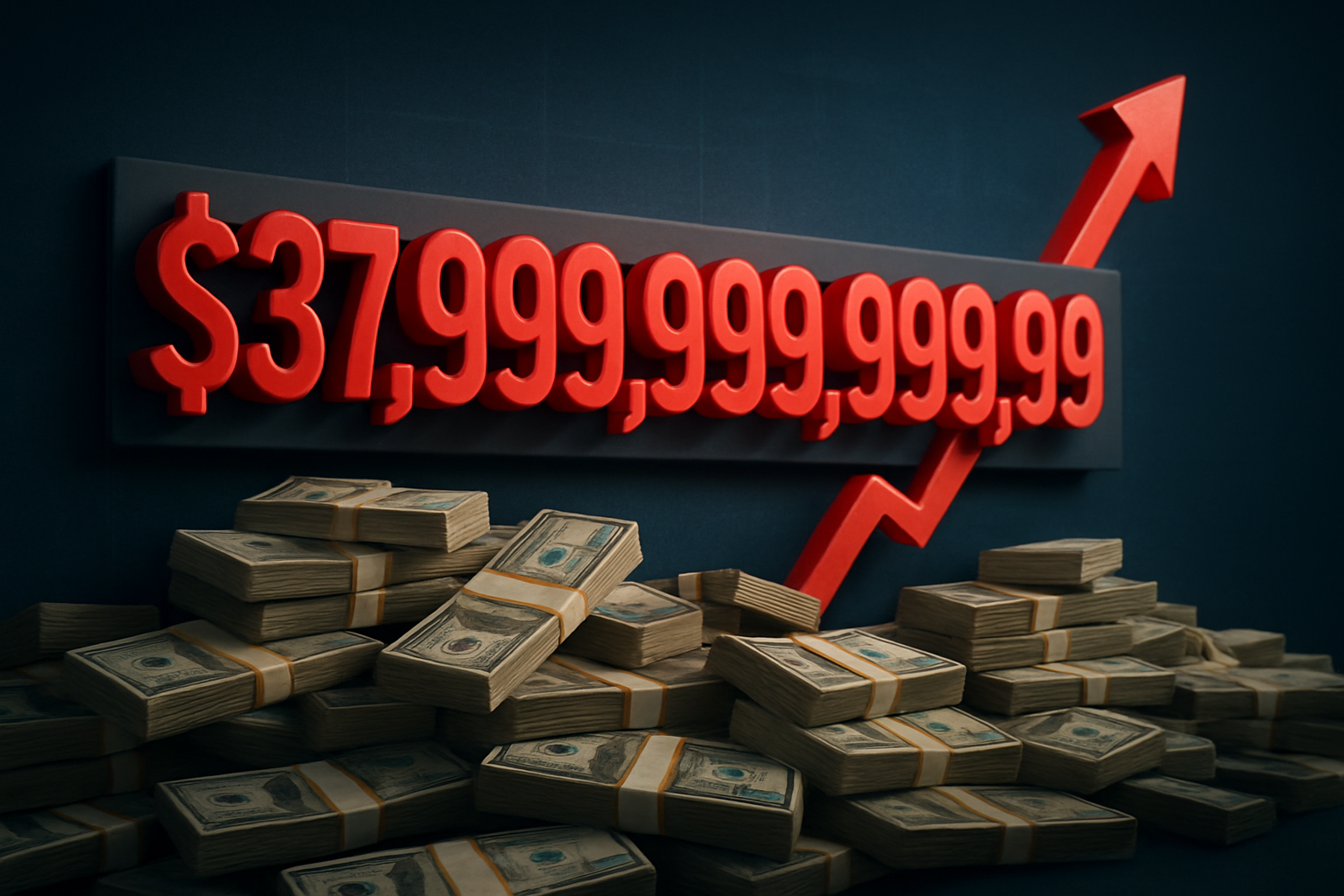
The United States national debt is expanding at an alarming rate, climbing by an estimated $6 billion every single day, according to recent data from the U.S. Congress Joint Economic Committee (JEC). The debt now stands at $37.9 trillion, rising by $69,890 per second — or about $4.2 million per minute.
At this pace, the U.S. is expected to surpass $38 trillion within the next 20 days, underscoring growing concerns about the country’s long-term fiscal stability.

Debt Growth Outpaces Global Economies
The daily increase in U.S. debt — $6 billion — exceeds the entire GDP of more than 30 countries, according to data from Worldometer.
Lawmakers are warning that this trend could spiral into a full-scale economic crisis if spending isn’t curtailed soon.
U.S. Representative Keith Self urged immediate action, stating that “Congress must act now—demand fiscal responsibility before the gradual slide becomes a sudden collapse.”
Economists caution that without decisive measures, total debt could reach $50 trillion within a decade.
Investors Flock to ‘Hard Assets’ Like Bitcoin and Gold
As confidence in the dollar wanes, investors are increasingly turning to Bitcoin and gold as hedges against currency debasement.
Last week, JPMorgan analysts described both assets as part of the “debasement trade”, noting that institutional demand for Bitcoin has surged amid rising fiscal uncertainty.
Bitcoin recently hit a new all-time high of $125,506, while gold reached a record $3,920 per ounce.
Analysts say the rally reflects investors’ growing preference for finite, non-sovereign assets amid concerns over unrestrained debt growth.
Institutional Voices Back Bitcoin as a Hedge
Even long-time skeptics are acknowledging Bitcoin’s resilience. Larry Fink, CEO of BlackRock, predicted earlier this year that Bitcoin could climb to $700,000 as fears of dollar debasement grow.
Similarly, Ray Dalio, founder of Bridgewater Associates, advised investors to allocate 15% of portfolios to hard assets like Bitcoin or gold to achieve a stronger risk-adjusted return.
Dalio added that the “debt doom loop” isn’t unique to the U.S. — European nations and the UK are also facing rising deficits and weaker currencies.
He described Bitcoin and gold as “effective diversifiers” against the global debt expansion.
Trump Administration’s Cost-Cutting Efforts Fall Short
President Donald Trump has prioritized deficit reduction as part of his fiscal agenda. In July, he signed the “Big Beautiful Bill Act,” projected to save $1.6 trillion in federal spending over the next decade.
Earlier in the year, Trump enlisted Elon Musk to advise the Department of Government Efficiency, a move that reportedly saved $214 billion before Musk’s short-term government role ended.
Despite these measures, implementing the spending bill ironically pushed total U.S. debt above $37 trillion, with long-term projections estimating an additional $3.4 trillion in costs over ten years.
Beyond the U.S., the Institute of International Finance reports that global debt has ballooned to $337.7 trillion by the end of Q2 2025 — the highest level in history. Analysts cite continued quantitative easing and a weaker dollar as the primary contributors.
With America’s fiscal position deteriorating rapidly, investors are once again asking a pressing question:
Can Bitcoin’s fixed supply and decentralization make it the ultimate hedge against unlimited debt creation?
Disclaimer
This content is for informational purposes only and does not constitute financial, investment, or legal advice. Cryptocurrency trading involves risk and may result in financial loss.