

Ethereum co-founder Vitalik Buterin has proposed integrating distributed validator technology (DVT) into Ethereum’s staking system, aiming to simplify staking for users and enhance network security. The proposal could make running validators more accessible while reducing penalties for downtime.
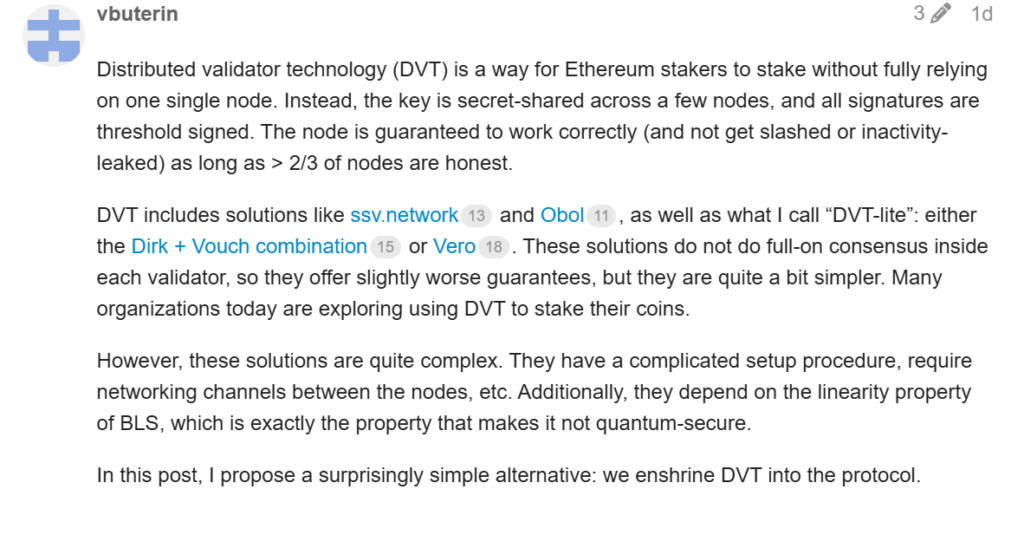
Currently, Ethereum validators rely on a single node to secure the network, exposing stakers to slashing penalties if the node fails. Buterin’s DVT approach allows a validator’s key to be shared across multiple nodes, with actions confirmed via threshold signatures. A validator remains functional as long as a majority of nodes are honest, improving uptime and reliability.
The proposal envisions a group identity system, where up to 16 “virtual identities” act independently but are treated as one by the protocol. Actions, such as block proposals, are considered valid only if a minimum number of identities sign off, with rewards or penalties distributed based on majority behavior.
Buterin pitched “native DVT” in a post to the Ethereum Research forum on Wednesday;
Implementing DVT directly into Ethereum’s protocol could simplify complex setups currently required by third-party solutions. It would also enable security-conscious stakers to manage their own ETH safely without relying on external providers, supporting greater decentralization.
Buterin emphasizes that while DVT solutions exist today, embedding them natively in the protocol could make staking simpler, more secure, and more resilient, though further discussion and testing are needed before network adoption.
Disclaimer
This content is for informational purposes only and does not constitute financial, investment, or legal advice. Cryptocurrency trading involves risk and may result in financial loss.