
A recent White House study concluded that stablecoin rewards are unlikely to significantly affect bank lending or broader credit conditions, offering a counterpoint to concerns from banks and trade groups.
Findings from the Council of Economic Advisers
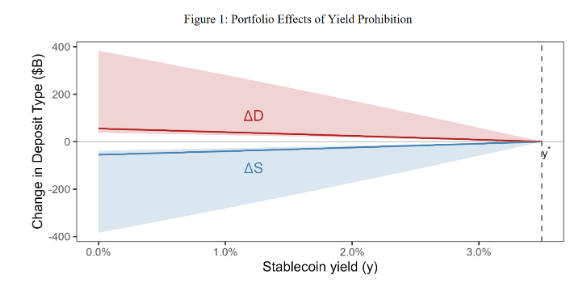
The report from the Council of Economic Advisers (CEA) found that prohibiting stablecoin yields would produce minimal benefits for banks. In the study’s base scenario, removing yield-bearing features increases lending by only $2.1 billion, roughly 0.02% of total U.S. loans, while imposing a net welfare cost on consumers.
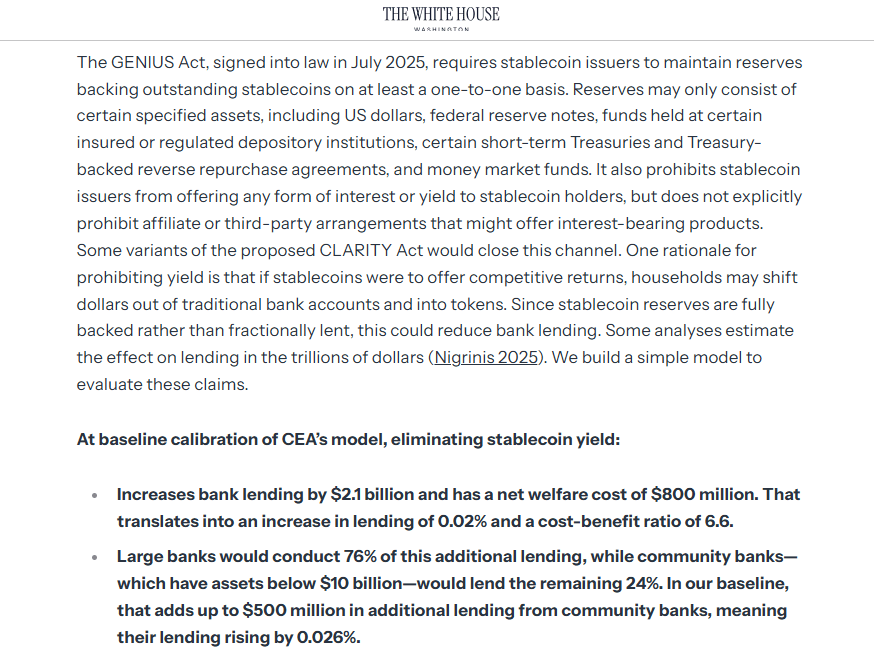
White House economists noted that most stablecoin reserves remain within the banking system, often invested in Treasurys or deposited elsewhere, limiting any material “flight” from traditional balance sheets. Only an estimated 12% of reserves is effectively excluded from lending, dampening the impact on credit creation.
Banking Sector Concerns
Banks and trade groups have warned that interest-bearing stablecoins could siphon trillions from deposits. The Independent Community Bankers of America projected potential losses of $1.3 trillion in deposits and $850 billion in reduced lending. Major banks, including Bank of America and JPMorgan, have urged regulators to apply bank-style rules to stablecoin yields to prevent a parallel deposit system.
Debates continue under the proposed Clarity Act, which seeks to restrict indirect yield mechanisms. Regulators are also implementing provisions under the GENIUS Act, ensuring one-to-one reserve backing and limiting direct yield payments.
Disclaimer
This content is for informational purposes only and does not constitute financial, investment, or legal advice. Cryptocurrency trading involves risk and may result in financial loss.