

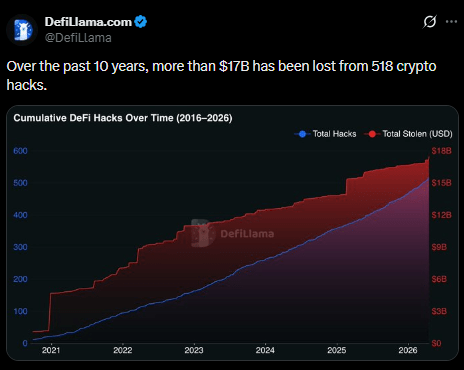
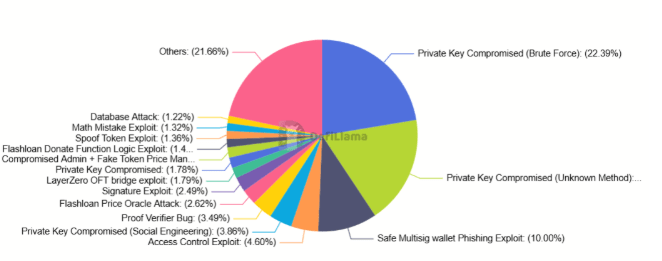
Crypto hackers have stolen more than $17 billion across 518 recorded incidents over the past 10 years, highlighting persistent security challenges across digital asset platforms. Data from DefiLlama shows that private key compromises remain one of the most costly attack methods, accounting for a significant share of total losses.
Among the identified attack methods, 22.3% of incidents were linked to private key breaches using brute-force techniques, while 18.2% were tied to unknown compromise methods. Additionally, 10% of attacks were connected to phishing campaigns targeting multi-signature wallets, reinforcing concerns about vulnerabilities in wallet security and credential management systems.
Recent DeFi Exploits Drive Rising Security Concerns
Security risks have intensified following one of the largest crypto thefts recorded in 2026, when attackers drained approximately 116,500 rsETH, valued between $290 million and $293 million, from a LayerZero-powered bridge used by Kelp DAO. The incident has renewed concerns about the safety of cross-chain infrastructure and signing tools.
Separate findings show that decentralized finance platforms lost more than $600 million over the past 60 days, with major losses tied to both the Kelp DAO exploit and an April 1 attack involving a Solana-based decentralized exchange known as Drift Protocol.
AI-Driven Malware and Social Engineering Expand Threat Landscape
Cybersecurity experts warn that advances in artificial intelligence and malware development are enabling attackers to scale social engineering schemes more efficiently. These scams often involve sending small test transactions to victims, hoping they copy malicious wallet addresses from transaction history.
Dyma Budorin, co-founder and CEO of cybersecurity firm Hacken, said the growing availability of hacking-as-a-service tools on darknet platforms is lowering entry barriers for attackers. According to additional industry data, Web3 projects lost $482 million in the first quarter of 2026 alone, with $306 million attributed to phishing and social engineering attacks, now considered the largest single threat vector.
Disclaimer
This content is for informational purposes only and does not constitute financial, investment, or legal advice. Cryptocurrency trading involves risk and may result in financial loss.