

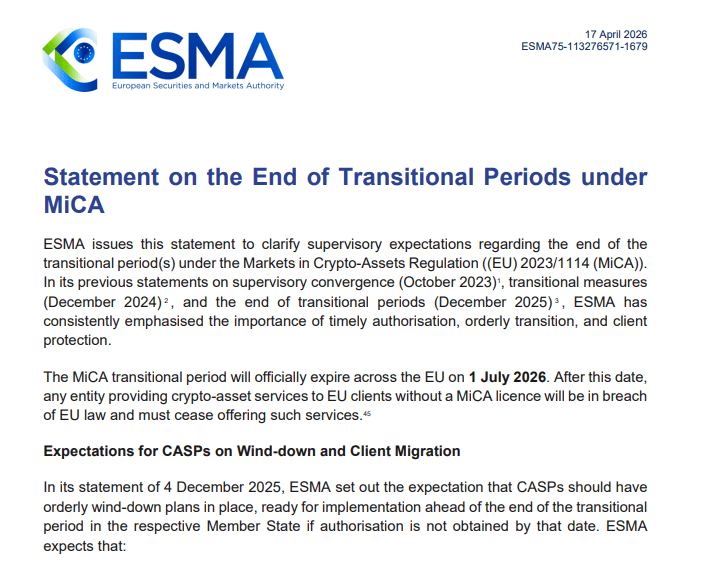
The European Union’s Markets in Crypto Assets (MiCA) regulation is entering its final transition phase, with the July 1 deadline marking the end of the longest 18-month grandfathering window. After this date, any crypto asset service provider operating without MiCA authorization must stop serving clients across the bloc. Early adopters such as CoinJar, which secured authorization in Ireland in 2025, view the framework as a step toward a more mature market, while smaller firms warn the timeline is becoming increasingly difficult to meet.
High Compliance Costs Raise Risk of Market Consolidation
The cost of licensing, governance restructuring and ongoing reporting is placing heavy financial pressure on smaller crypto businesses and hybrid projects. In Poland, Ari10 founder Mateusz Kara noted that out of roughly 2,000 registered virtual asset service providers, only his group has secured a MiCA license so far, raising concerns that many firms could shut down. Industry figures such as Matthew Pinnock and Taran Dhillon have also warned that uniform authorization rules could push early-stage projects to relocate outside Europe.
DeFi Classification and Regulatory Uncertainty Remain Key Challenges
MiCA exempts fully decentralized services under Recital 22, but many decentralized finance systems fall into a gray area. Supervisors maintain that the framework supports innovation and investor protection, yet debate continues over whether stricter oversight will strengthen Europe’s crypto sector or drive new development offshore.
Disclaimer
This content is for informational purposes only and does not constitute financial, investment, or legal advice. Cryptocurrency trading involves risk and may result in financial loss.