


Photo: Illustrative
6.9 Million BTC at Risk as Bitcoin Confronts Post-Quantum Security Challenge
Quantum computers are not expected to disrupt Bitcoin mining or the blockchain ledger itself, but they could eventually compromise the cryptography that protects wallet ownership. Mining relies on hashing, a mathematical process that quantum machines cannot meaningfully break, meaning new blocks would still be produced and the network would continue operating.

Quantum Computing Risk Targets Bitcoin Wallet Ownership
Quantum computers are not expected to disrupt Bitcoin mining or the blockchain ledger itself, but they could eventually compromise the cryptography that protects wallet ownership. Mining relies on hashing, a mathematical process that quantum machines cannot meaningfully break, meaning new blocks would still be produced and the network would continue operating.
The real vulnerability lies in wallet security. Bitcoin ownership depends on private keys that generate public addresses through one-way mathematical functions. Classical computers cannot reverse this process within a practical timeframe, but a quantum method known as Shor’s algorithm could make reversing public keys possible.
Research released by Google suggests such attacks may require fewer resources than previously believed, increasing concerns about future risks to digital asset security.
Millions of Bitcoin Already Exposed to Future Quantum Attacks
An estimated 6.9 million bitcoin, roughly one-third of all mined supply, is considered vulnerable because the public keys linked to those coins are already visible on-chain. This includes early holdings attributed to Bitcoin’s pseudonymous creator Satoshi Nakamoto, believed to control about 1 million bitcoin untouched since the network’s early years.
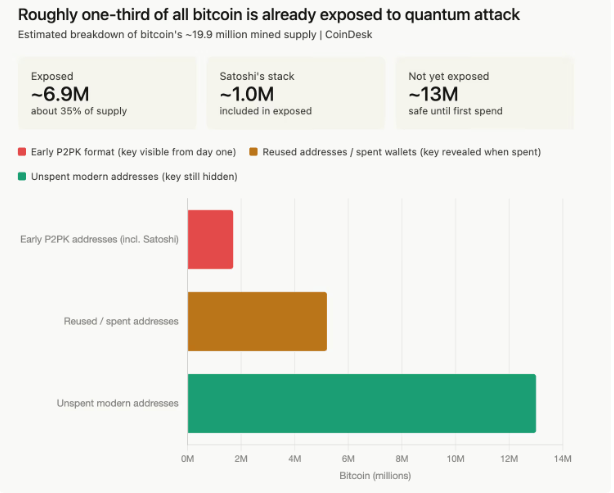
Coins spent since the Taproot upgrade in 2021 also fall into the exposed category, as spending transactions reveal the public keys securing remaining balances. Unlike real-time transaction attacks, quantum attackers could target exposed wallets gradually without racing against active transfers.
Bitcoin Lacks Unified Post-Quantum Migration Strategy
While competing blockchain ecosystems have launched structured responses, Bitcoin does not yet have a unified roadmap for quantum-resistant security. Ethereum, supported by the Ethereum Foundation, began developing post-quantum protections in 2018, funding multiple teams to test new cryptographic standards and coordinate upgrades.
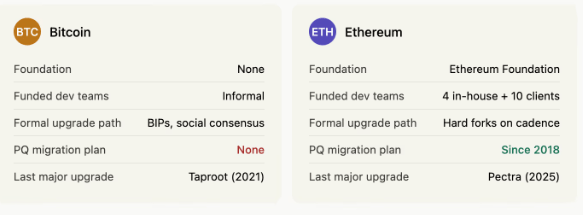
Within Bitcoin’s development community, proposals such as BIP-360 aim to introduce quantum-safe address formats, while research groups including BitMEX Research have suggested monitoring systems to detect quantum attacks. However, none of these proposals has gained widespread consensus among core developers.
Governance Challenges Could Slow Critical Security Upgrades
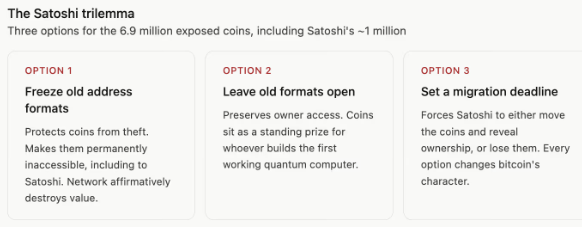
Bitcoin’s decentralized governance model makes large-scale changes difficult to coordinate. Decisions about freezing older address formats or forcing migrations to quantum-safe wallets could affect millions of coins, including long-inactive holdings.
Some experts warn that waiting until quantum hardware becomes capable of real attacks could leave limited time to respond. Others argue that building optional upgrades in advance would allow gradual migration without disrupting the network’s stability.
Disclaimer
This content is for informational purposes only and does not constitute financial, investment, or legal advice. Cryptocurrency trading involves risk and may result in financial loss.
Live market reaction
Disclaimer
This content is for informational purposes only and does not constitute financial, investment, or legal advice. Cryptocurrency trading involves risk and may result in financial loss.
Start trading
with BloFin today
Up to $500 sign-up bonus and zero-fee trading on your first 30 days.
Buy crypto nowⓘ You will be redirected to BloFin
About the author
Covers Bitcoin, on-chain data and market structure. Breaks down what the charts and wallet flows are actually saying, without the hype.

 Guylian ·

.jpeg&w=32&q=75) Laurisa ·
Laurisa ·