
Photo: Illustrative
Anthropic AI Model Traces 25 Year Old NSA Curve Seeds to an Ordinary Random Generator
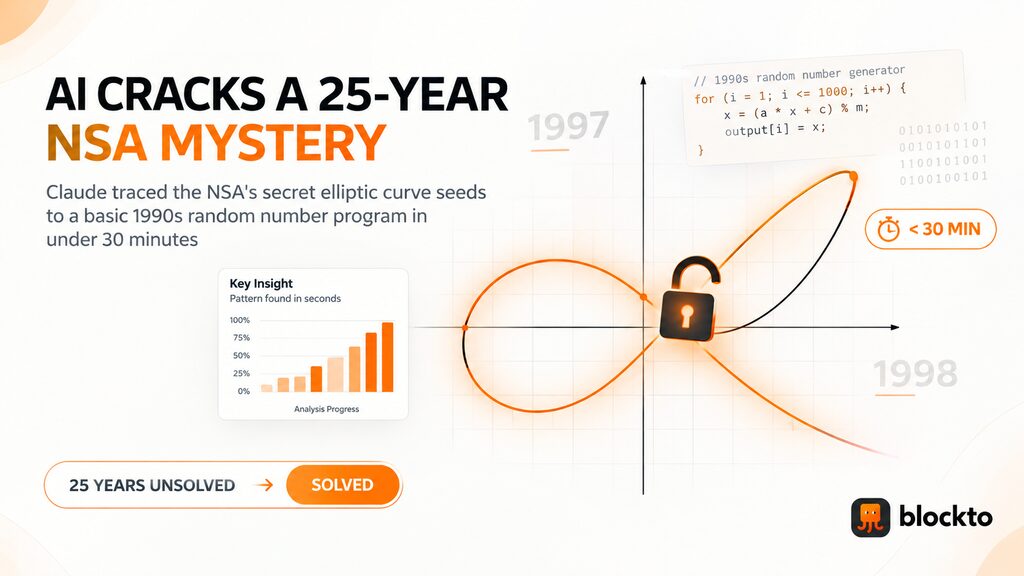
An Anthropic research model has answered a question cryptographers chased for about 25 years: where the starting numbers behind several NIST curves came from. In under half an hour, it linked five seeds, handed to the government by the NSA in the late 1990s, to lrand48, a basic random number tool found in older C libraries, fed with timestamps from 1997 and 1998. The model was not told about the old theory that the seeds came from a forgotten phrase. It matched the published P-256 seed at the 1,842nd candidate.

An Anthropic research model has answered a question cryptographers chased for about 25 years: where the starting numbers behind several NIST curves came from. In under half an hour, it linked five seeds, handed to the government by the NSA in the late 1990s, to lrand48, a basic random number tool found in older C libraries, fed with timestamps from 1997 and 1998. The model was not told about the old theory that the seeds came from a forgotten phrase. It matched the published P-256 seed at the 1,842nd candidate.
Why the Seeds Raised Suspicion
NIST adopted the NSA designed curves in 2000 without any explanation of the seeds. Doubts grew after the Snowden leaks tied the agency to weakened standards, including the Dual EC generator. Researchers Neal Koblitz and Alfred Menezes studied the dispute in 2015, and Steve Weis spent years pursuing records. A bounty launched in 2023 by Filippo Valsorda and others remained unclaimed, and NSA mathematician Jerry Solinas had died earlier that year.
What It Means for Bitcoin Security
Anyone can now rerun the program and reproduce the numbers, which makes a hidden weakness far less likely, though some questions about the candidates remain open. Anthropic says users of the NIST curves need not change anything. Bitcoin never used these curves. It relies on secp256k1, defined by two small fixed values that leave little room for tampering.
Quantum Risk Remains Separate
A strong quantum computer could still derive secret keys from public keys on the blockchain, whatever the curve’s origin. Google said this week that its Willow chip cut errors about 40-fold in a costly preparation step, yet no machine is close to breaking a bitcoin key. The $36,864 bounty goes to the Internet Security Research Group, the nonprofit behind Let’s Encrypt.
Live market reaction
Disclaimer
This content is for informational purposes only and does not constitute financial, investment, or legal advice. Cryptocurrency trading involves risk and may result in financial loss.
Start trading
with BloFin today
Up to $500 sign-up bonus and zero-fee trading on your first 30 days.
Buy crypto nowⓘ You will be redirected to BloFin
About the author
Covers Bitcoin, on-chain data and market structure. Breaks down what the charts and wallet flows are actually saying, without the hype.

 Guylian ·


 Laurisa ·