


Photo: Illustrative
Bitcoin Core 32 Enters Final Testing With Fee Estimation And Security Fixes
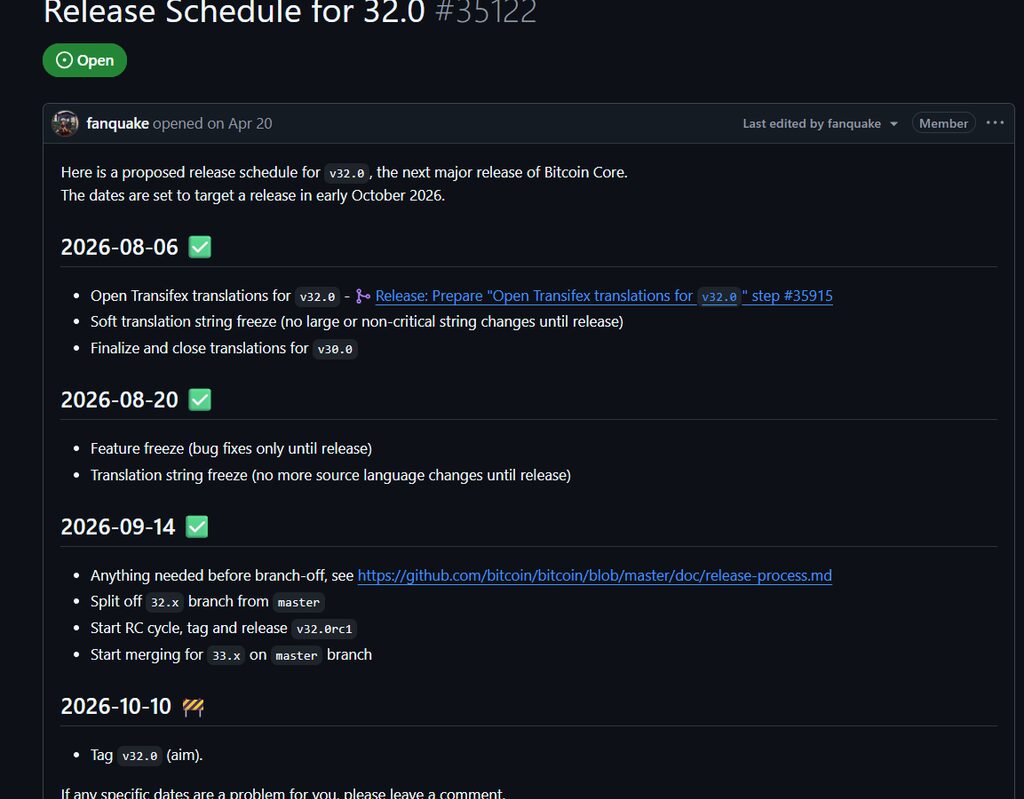
Bitcoin Core, the software that powers most Bitcoin nodes, has entered final testing for its next major release, bringing changes to how fees are estimated, how blocks are processed, and fixing several security vulnerabilities ahead of an October 10 launch.
.jpeg)
Bitcoin Core, the software that powers most Bitcoin nodes, has entered final testing for its next major release, bringing changes to how fees are estimated, how blocks are processed, and fixing several security vulnerabilities ahead of an October 10 launch.
Faster Fee Estimates And Block Processing
The update introduces a second fee estimation method that looks at transactions currently waiting for confirmation, alongside the existing approach based on past blocks. This should let fee estimates drop more quickly once network congestion clears, rather than lagging behind based on older, pricier transactions. Nodes will also be able to pull transaction data using multiple processing threads simultaneously, with eight threads used by default, reducing wait times for nodes still catching up with the blockchain. None of these changes affect Bitcoin’s core consensus rules.
Security Fixes Address Wallet And Memory Vulnerabilities
Developers patched a flaw present since Bitcoin Core 24.0 that could have allowed an authenticated user to run unauthorized commands on a node’s host computer by creating a specially named wallet, provided a certain notification feature was enabled. The new version now treats wallet names strictly as text rather than executable input. Separately, an audit using an AI model uncovered a memory-exhaustion vulnerability in a new web server component still in development, where repeated data requests could overwhelm a node’s memory. Testing showed the flaw could push memory usage from 46 MB to roughly 3 GB in about a minute before the fix, and about 3 MB afterward. The issue was caught before shipping in any stable release.
Wallet Format Changes
Several wallet related commands used to build partially signed transactions will now default to a newer, updated data format, an important consideration for services and hardware wallets that interact directly with Bitcoin Core’s transaction-building tools.
Live market reaction
Disclaimer
This content is for informational purposes only and does not constitute financial, investment, or legal advice. Cryptocurrency trading involves risk and may result in financial loss.
Start trading
with BloFin today
Up to $500 sign-up bonus and zero-fee trading on your first 30 days.
Buy crypto nowⓘ You will be redirected to BloFin
About the author
Emerging voice in crypto journalism with a background in fintech and digital economics. Covers DeFi, NFTs, and the evolving regulatory landscape.

.jpeg&w=32&q=75) Laurisa ·
Laurisa · 

 Tristan R. ·